Découvrez les bienfaits de la lumière UVB pour la santé
La lumière UVB est essentielle à la santé et stimule certains des processus biologiques les plus importants de votre corps.
Spectre étroit, grands avantages
La lumière UVB représente moins de 1 % de la lumière du soleil qui atteint la surface de la Terre, et pourtant, elle est à l'origine de certains des effets biologiques les plus importants de l'organisme. Solius concentre 95 % de son rayonnement dans le spectre d'action UVB, avec un pic ciblé de 293 nm, pour offrir plus de bienfaits de la lumière UVB que le soleil, avec 99 % de risques liés aux UV en moins.
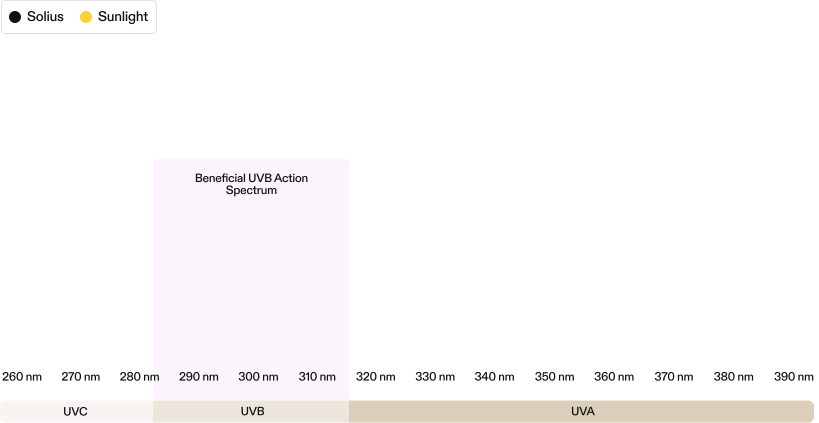
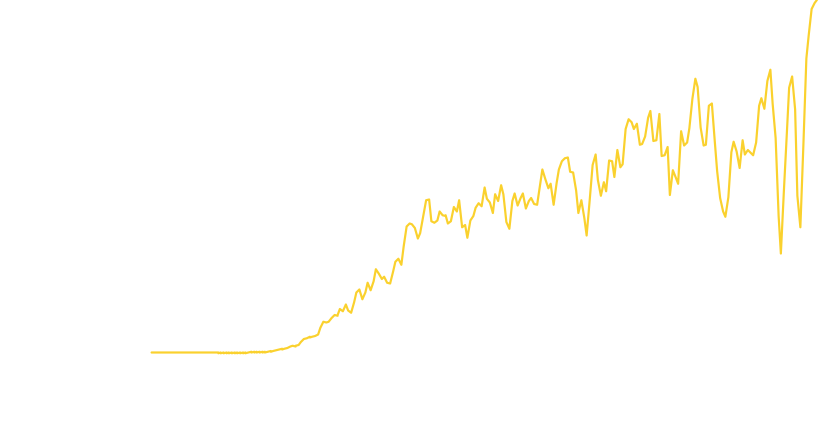
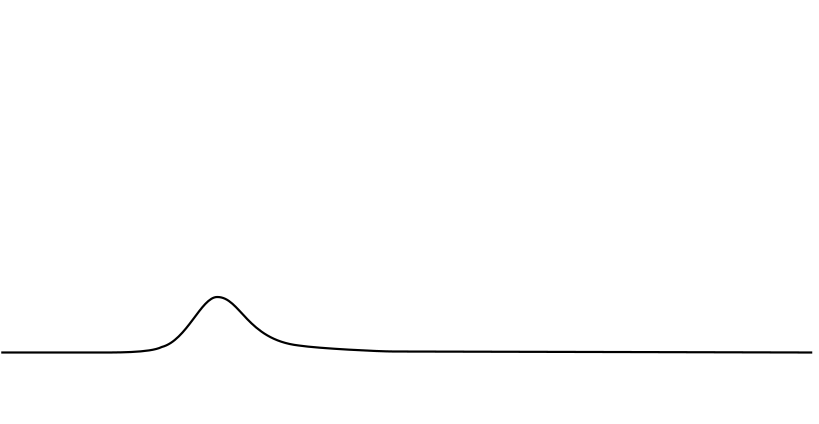
Solius procure 12 fois plus de bienfaits pour la santé liés aux rayons UVB que le soleil
Éclairement énergétique absolu (uW/cm²)
Longueur d'onde (nm = nanomètres)
Spectre solaire de référence : ASTM G173 AM 1.5 (équivalent à un IUV de 9-11+)
La lumière du soleil est bien plus que de la vitamine D
Les suppléments ne peuvent pas reproduire l'éventail complet des bienfaits associés à l'exposition à la lumière UVB naturelle
De nombreuses études ont démontré que la supplémentation orale n’est pas aussi efficace que l’exposition au soleil. Votre peau absorbe les rayons UVB et les convertit en hormones et en signaux qui améliorent la communication entre les systèmes de votre corps, ce qui influence l’humeur, la concentration, l’énergie, la fonction immunitaire et la santé intestinale de l’intérieur. Les recherches montrent que les changements biologiques commencent immédiatement et se renforcent avec une exposition régulière.

Comment la lumière UVB affecte votre corps
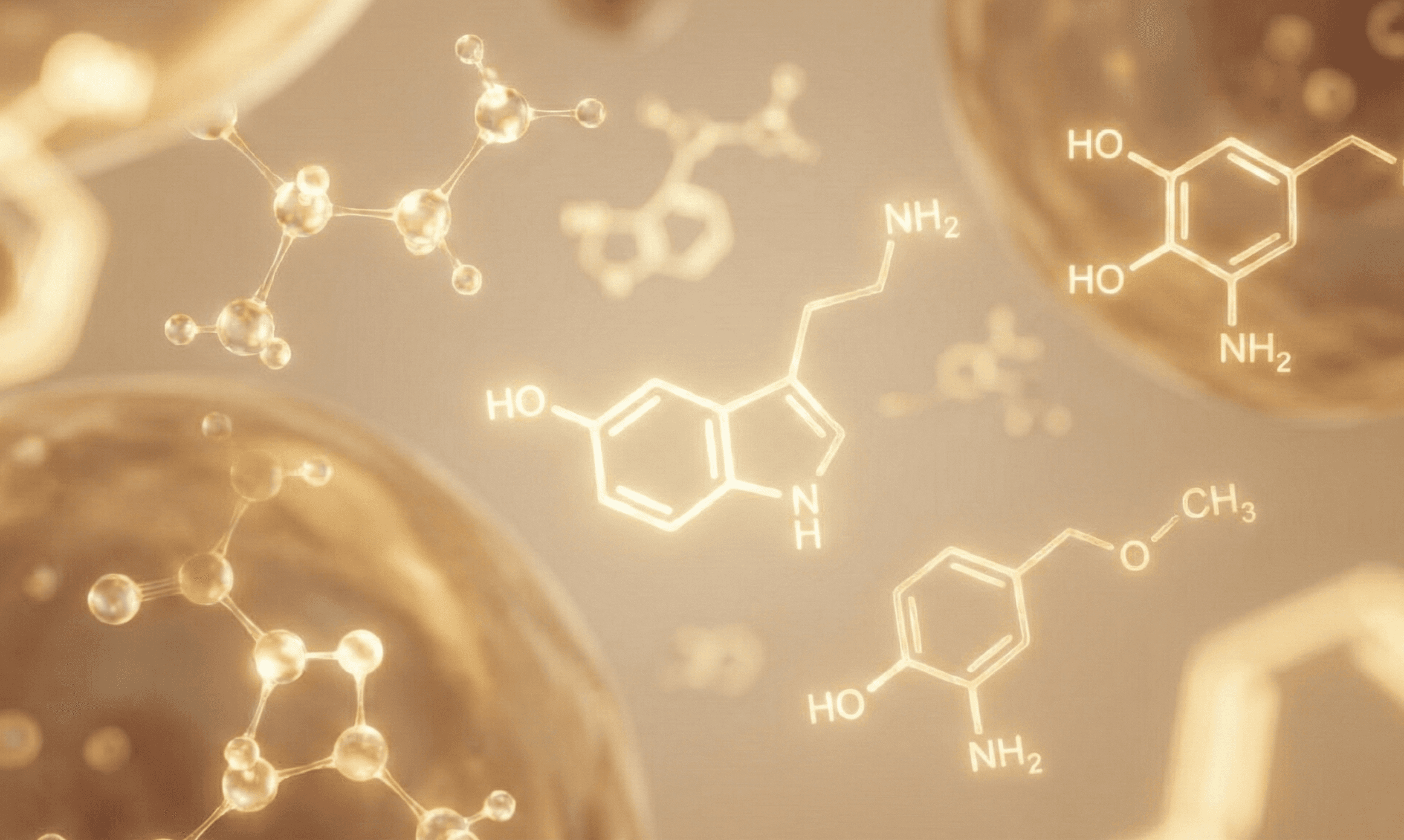
Les neurotransmetteurs, l'oxyde nitrique et les hormones sont activés
Qu'est-ce qui se passe
La lumière UVB déclenche la libération d'oxyde nitrique, de bêta-endorphines, de précurseurs de la sérotonine, de peptides liés à la dopamine et de composés anti-inflammatoires comme le calcitriol et le lumistérol.
Pourquoi c'est important
Ces molécules améliorent l'humeur, l'énergie, la gestion du stress, le contrôle moteur et l'apprentissage, tout en offrant une neuroprotection à long terme contre le déclin cognitif. Les effets commencent peu de temps après l'exposition et peuvent durer de quelques heures à plusieurs jours.

La production de vitamine D commence, optimisant l'expression des gènes
Qu'est-ce qui se passe
Quelques secondes seulement après l'exposition aux UVB, votre peau transforme le 7-déshydrocholestérol en prévitamine D₃, qui devient de la vitamine D₃ active au cours des 24 à 48 heures suivantes.
Pourquoi c'est important
La vitamine D agit comme une hormone qui influence plus de 1 000 gènes, favorisant la force osseuse, la résilience immunitaire et la santé métabolique.
L'équilibre du microbiome et l'intégrité intestinale s'améliorent
Qu'est-ce qui se passe
La lumière UVB renforce les microbiomes de votre peau et de votre intestin. Sur la peau, les peptides antimicrobiens naturels augmentent, ce qui aide les bonnes bactéries à proliférer tout en réduisant l'inflammation. Grâce à l'axe intestin-peau, les UVB favorisent la production d'acides aminés et de mucus, favorisant ainsi l'absorption des nutriments, l'intégrité de la barrière intestinale et la diversité microbienne.
Pourquoi c'est important
Un microbiome équilibré améliore la santé et l'apparence de la peau, réduit l'inflammation chronique et soutient la digestion, l'immunité ainsi que la régulation de l'humeur. Les améliorations cutanées locales commencent en quelques jours, et la diversité du microbiome intestinal augmente progressivement sur une période de 2 à 4 semaines.
L'impact de l'évitement du soleil
820 000
nombre annuel estimé de décès aux États-Unis et en Europe qui pourraient être liés à une exposition insuffisante au soleil
75 : 1
pour chaque décès par cancer de la peau évité en évitant l'exposition au soleil, 75 décès dus à d'autres causes pourraient s'ensuivraient
Plus de 5 000 études scientifiques
reliant la lumière UVB et la vitamine D à un large éventail de conditions de santé
Sclérose en plaques
Diabète
Accident vasculaire cérébral
Cancer du sein
Cancer du côlon
Obésité
Dépression
Ostéoporose
Alzheimer
Maladies auto-immunes
Migraines et vertiges
Maladies inflammatoires chroniques de l'intestin
Naissance prématurée
Prééclampsie
Maladies de la peau
Infertilité
Sclérose en plaques
Diabète
Accident vasculaire cérébral
Cancer du sein
Cancer du côlon
Obésité
Dépression
Ostéoporose
Alzheimer
Maladies auto-immunes
Migraines et vertiges
Maladies inflammatoires chroniques de l'intestin
Naissance prématurée
Prééclampsie
Maladies de la peau
Infertilité
« L'évitement de l'exposition au soleil est un facteur de risque de décès d'une ampleur similaire à celle du tabagisme »
La luminothérapie Solius offre en toute sécurité 12 fois plus de bienfaits pour la santé liés aux rayons UVB que le soleil, avec un dosage personnalisé

Même par temps clair et ensoleillé en été, divers facteurs font qu'il est extrêmement difficile d'obtenir une dose bénéfique de rayons UVB du soleil.
" height="20px" id="nSAZRt8Fe" transform="translate(2 2)" width="20px"/></svg>)
Vie moderne
Les fenêtres en verre, les vêtements et la crème solaire bloquent les rayons UVB.
" width="20px"><path d="M 10 2.721 L 10 17.231 M 7.279 0 L 10 2.721 L 12.72 0 M 7.279 19.952 L 10 17.231 L 12.72 19.952 M 3.717 6.348 L 16.283 13.604 M 0 7.344 L 3.717 6.348 L 2.721 2.632 M 17.279 17.32 L 16.283 13.604 L 20 12.608 M 3.717 13.604 L 16.283 6.348 M 2.721 17.32 L 3.717 13.604 L 0 12.608 M 20 7.344 L 16.283 6.348 L 17.279 2.632" fill="transparent" height="19.95193280235113px" id="zlqrYMOiz" stroke-dasharray="" stroke-linecap="round" stroke-linejoin="round" stroke-width="2" stroke="rgb(0, 0, 0)" transform="translate(0 0)" width="20px"/></g></svg>)
Saison
L'angle bas du soleil bloque les rayons UVB pendant une grande partie de l'année.
" width="19.581306024328075px"><path d="M 1.952 0 C 3.371 1.51 4.08 3.47 4.08 5.882 C 4.08 9.5 1.002 12.27 0.486 14.25 C 0.144 15.57 -0.018 17.154 0.002 19 M 17.63 0 C 16.211 1.51 15.502 3.47 15.502 5.882 C 15.502 9.5 18.58 12.269 19.095 14.25 C 19.439 15.57 19.6 17.154 19.58 19" fill="transparent" height="19px" id="FrSSj51Ei" stroke-dasharray="" stroke-linecap="round" stroke-linejoin="miter" stroke-miterlimit="10" stroke-width="2" stroke="rgb(0, 0, 0)" width="19.581306024328075px"/><path d="M 0 0 C 3.263 2.065 6.225 3.097 8.889 3.097 C 11.552 3.097 14.368 2.065 17.338 0" fill="transparent" height="3.0970000000000013px" id="WQpAAC_rq" stroke-dasharray="" stroke-linecap="round" stroke-linejoin="miter" stroke-miterlimit="10" stroke-width="2" stroke="rgb(0, 0, 0)" transform="translate(1 13)" width="17.338000000000022px"/><path d="M 1.25 2.5 C 1.94 2.5 2.5 1.94 2.5 1.25 C 2.5 0.56 1.94 0 1.25 0 C 0.56 0 0 0.56 0 1.25 C 0 1.94 0.56 2.5 1.25 2.5 Z" fill="rgba(0, 0, 0, 0.65)" height="2.5px" id="AvKacFegN" transform="translate(9 10.5)" width="2.5px"/><path d="M 1 0 C 1.552 0 2 0.448 2 1 C 2 1.552 1.552 2 1 2 C 0.448 2 0 1.552 0 1 C 0 0.448 0.448 0 1 0 Z" fill="transparent" height="2px" id="npuJwtlx9" stroke-dasharray="" stroke-linecap="butt" stroke-linejoin="miter" stroke-miterlimit="10" stroke-width="0.5" stroke="rgb(0, 0, 0)" transform="translate(9 11)" width="2px"/></g></svg>)
Peau exposée
Nécessite de grandes zones de peau directement exposées au soleil.
Météo
Les nuages, la brume sèche et la pollution absorbent la lumière UVB.
Moment de la journée
La lumière UVB efficace n’apparaît que pendant quelques heures en milieu de journée.
La photothérapie UVB de Solius est-elle pour vous ?
Comment la technologie révolutionnaire de la lumière UVB est conçue pour relever les défis courants.








Conçu pour la sécurité
Posologie personnalisée
Les doses sont calculées en fonction de la mesure de votre peau pour des résultats sûrs et efficaces.
Risque de rayons UV réduit de 99 %
Le spectre de précision offre un risque d’exposition aux UV réduit de 99 % par rapport à la lumière naturelle du soleil.
Équivalent de sécurité de 5 minutes
Le risque d'exposition aux UV d'une année complète de thérapie hebdomadaire Solius équivaut au risque de cinq minutes de soleil d'après-midi.
Photothérapie UVB à bande étroite de nouvelle génération
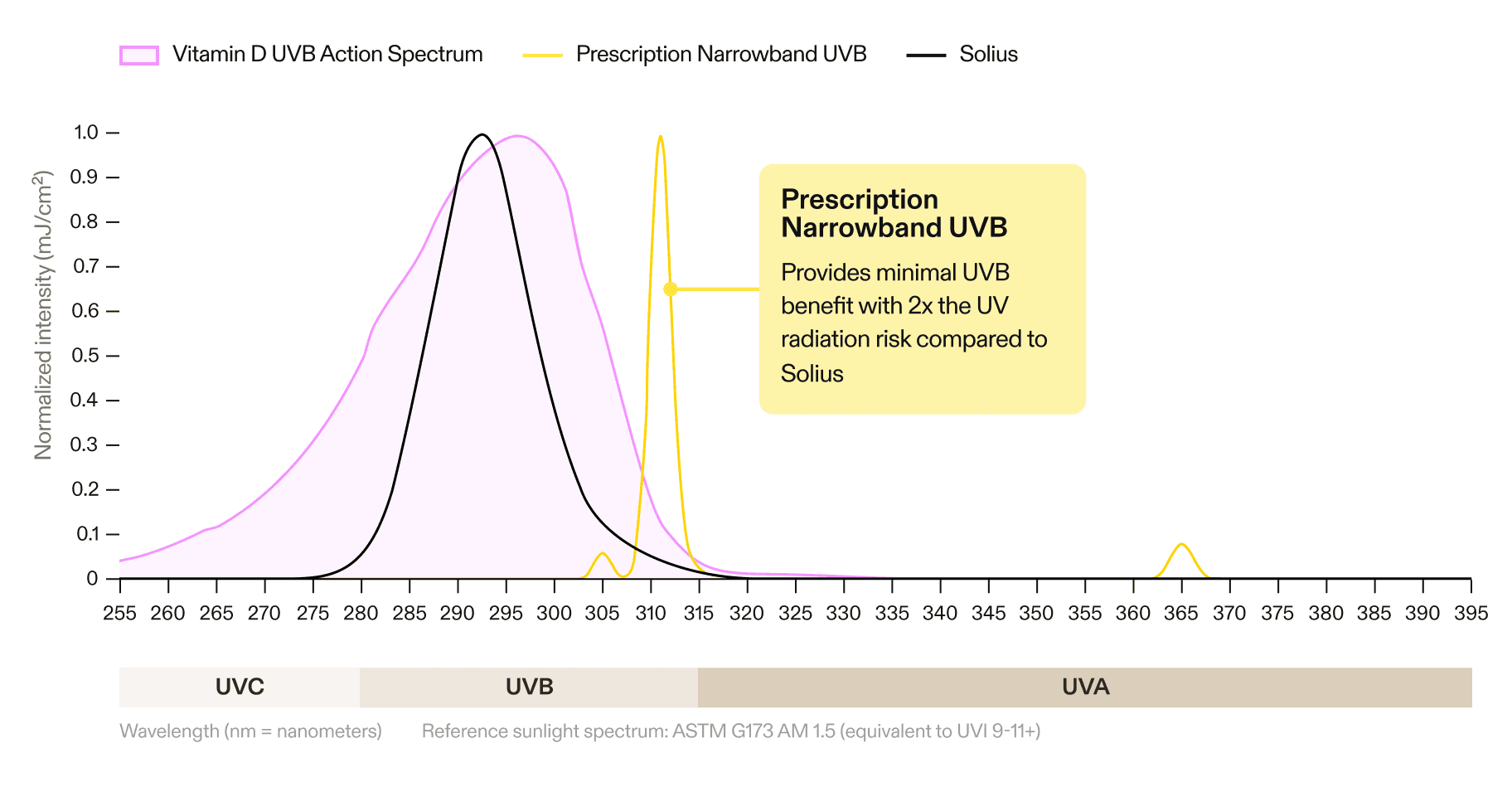
Contrairement aux appareils UVB à bande étroite sur ordonnance, Solius concentre 95 % de son émission dans le spectre d'action UVB optimal, avec 50 % de risques de rayonnement UV total en moins.
Spectre d'action UVB pour la vitamine D
Photothérapie UVB à bande étroite sur ordonnance
Solius

Photothérapie UVB à bande étroite sur ordonnance
Procure un bienfait minimal contre les UVB avec un risque de rayonnement UV deux fois plus élevé qu'avec Solius
1,0
0,9
0,8
0,7
0,6
0,5
0,4
0,3
0,2
0,1
0
Intensité normalisée (mJ/cm²)
255
260
265
270
275
280
285
290
295
300
305
310
315
320
325
330
335
340
345
350
355
360
365
370
375
380
385
390
395
UVC
UVB
UVA
Longueur d'onde (nm = nanomètres)
Spectre solaire de référence : ASTM G173 AM 1.5 (équivalent à un IUV de 9-11+)
En vedette
Pour la défense de la lumière du soleil
« Solius : le premier à commercialiser une lampe en vente libre autorisée par la FDA de nouvelle génération pour augmenter les niveaux de vitamine D. »
Rowan Jacobsen, Plaidoyer pour le soleil
Foire aux questions
Est-ce que Solius est sécuritaire?
Solius procure un bienfait de lumière UVB supérieur à celui du soleil naturel, tout en présentant un risque nettement moindre, en diffusant la lumière UVB de manière hautement contrôlée, constante et mesurée. Bien que toute exposition aux rayons UV comporte certains risques, Solius réduit les risques au minimum en utilisant une longueur d'onde précise et un capteur cutané intégré qui personnalise chaque séance.
Les séances Solius durent environ 5 minutes et procurent une dose de vitamine D équivalente à 60 minutes d'exposition au soleil naturel par un après-midi ensoleillé à une latitude moyenne (ASTM G173 AM 1,5 ou un IUV de 9 à 11+), ce qui rend Solius 12 fois plus efficace à stimuler la production de vitamine D par minute d'exposition dans des conditions optimales.
Pour mettre les choses en perspective, une année complète de séances hebdomadaires Solius présente un risque d'exposition aux UV inférieur à celui de seulement cinq minutes de soleil d'après-midi, soit moins d'une seconde d'exposition au soleil par jour.
Lorsqu'il est mesuré sur l'ensemble du spectre de la lumière UV, Solius émet environ 99 % de rayonnement UV total en moins que la lumière naturelle du soleil. Combiné au système novateur de dosage personnalisé Solius, cela vous garantit de recevoir une dose sûre, efficace et personnalisée pour votre peau. Cela réduit considérablement le risque de coup de soleil, de bronzage, de vieillissement prématuré ou de dommages cutanés liés aux rayons UV.
En quoi Solius est-il différent des suppléments de vitamine D?
Solius active la production naturelle de vitamine D de votre corps grâce à la lumière, contrairement aux pilules qui dépendent de la digestion et peuvent s'avérer inefficaces pour les personnes souffrant de problèmes de malabsorption. Plutôt que de s'en remettre au foie et aux reins pour traiter les suppléments, la production d'hormones commence par l'exposition de la peau aux UVB, là où la vitamine D est censée être produite. La vitamine D produite par Solius est autorégulée et équilibrée, aidant votre corps à créer exactement ce dont il a besoin. Dans une étude clinique publiée (Shirvani & Holick, Anticancer Research 2025), Solius a produit une augmentation individuelle moyenne de 76 % (10,2 ng/mL) de la vitamine D sérique.
La vitamine D créée naturellement par l'exposition à la lumière dure plus longtemps dans le corps et soutient des processus biologiques plus larges liés à l'humeur, à l'immunité et à l'équilibre métabolique. Au-delà de la vitamine D, la lumière UVB aide également à activer d'autres voies biologiques liées à la lumière que les suppléments ne peuvent pas atteindre, soutenant ainsi la santé globale, la vitalité et le bien-être général. C'est un moyen plus complet et naturellement aligné de soutenir votre santé de l'intérieur, et contrairement aux suppléments, Solius est homologué par la FDA.
De nombreux bienfaits pour la santé associés à la lumière du soleil n'apparaissent pas avec une seule supplémentation orale. Cela suggère que la thérapie par la lumière UVB est bien plus que de la vitamine D. Bien que la vitamine D soit le biomarqueur de l'exposition au soleil le plus étudié, elle n'est probablement pas le mécanisme principal de la thérapie par la lumière UVB. La recherche scientifique montre que la thérapie par la lumière UVB active la production d'hormones, stimule les métabolites favorables, libère de l'oxyde nitrique et favorise un microbiome diversifié.
En quoi Solius diffère-t-il du soleil ?
La lumière du soleil est difficile à doser, varie selon les saisons et la météo, et comprend des longueurs d'onde qui peuvent endommager la peau. La photothérapie UVB de Solius est contrôlée, constante et personnalisée pour votre peau à l'aide d'un capteur de pointe qui garantit que chaque dose vous convient.
Le soleil fournit une lumière UV à la fois bénéfique et nocive. Bien que la lumière naturelle du soleil déclenche la production de vitamine D, elle comprend également des rayons UVA qui peuvent endommager la peau et augmenter les risques pour la santé à long terme. Solius isole uniquement les longueurs d'onde UVB précises éprouvées pour stimuler la production de vitamine D, sans l'excès de rayonnement UV qui cause des brûlures, le vieillissement ou des dommages à l'ADN. Solius offre les bienfaits pour la santé de la lumière UVB du soleil avec 99 % moins de risques UV totaux.
En quoi Solius diffère-t-il des lampes de luminothérapie contre le TAS, de la thérapie par la lumière rouge ou des lits de bronzage?
La technologie novatrice et innovante de Solius utilise un spectre de lumière précis qui procure à la peau les bienfaits de l'exposition aux rayons UVB. Il s'agit d'une technologie différente de celle des lampes de traitement du TAS (trouble affectif saisonnier), de la thérapie par la lumière rouge et des lits de bronzage.
Les lampes de traitement du TAS et les appareils de thérapie par la lumière rouge utilisent une lumière visible de plus faible énergie - et non des rayons UVB - et n'activent donc pas les réponses biologiques liées aux UVB.
Les lits de bronzage émettent principalement des longueurs d'onde UVA (souvent 95 % ou plus) associées au vieillissement et aux dommages cutanés, et ils stimulent une quantité négligeable de bienfaits des UVB pour la santé, comme la vitamine D.
Solius utilise des longueurs d'onde UVB précises dont les recherches démontrent qu'elles activent la production d'hormones, favorisent les métabolites bénéfiques et encouragent un microbiome diversifié, le tout sans les longueurs d'onde UVA nocives que l'on retrouve dans les lits de bronzage ou la lumière naturelle du soleil.
Comment la lumière UVB affecte-t-elle votre santé?
Plusieurs grandes études de population, telles que Avoidance of sun exposure as a risk factor for major causes of death et Higher ultraviolet light exposure is associated with lower mortality, ont démontré qu'une plus grande exposition au soleil est liée à une mortalité plus faible et à une espérance de vie plus longue. Bien que cela ait souvent été attribué à la vitamine D, les études sur la supplémentation n'ont pas systématiquement montré les mêmes avantages, ce qui suggère que la vitamine D n'explique qu'une partie de cet effet.
La publication issue d'un examen d'experts de 2024, intitulée Beneficial health effects of ultraviolet radiation: expert review and conference report, a rassemblé des recherches cliniques et biologiques pour démontrer que l'exposition aux UVB influence de multiples systèmes de l'organisme - y compris les voies cardiovasculaires, immunitaires, métaboliques et neuroendocriniennes - par le biais de mécanismes qui dépassent le cadre de la vitamine D.
Des études mécanistes aident également à expliquer ce fonctionnement. L'étude Photo-neuro-immuno-endocrinology: How the ultraviolet radiation regulates the body, brain, and immune system décrit comment l'exposition aux UVB active un large éventail d'hormones, de neurohormones, de neurotransmetteurs et de médiateurs immunitaires - y compris la sérotonine, les peptides liés à la dopamine et les composés anti-inflammatoires. Ces signaux peuvent influer sur l'humeur, la régulation du stress, l'équilibre énergétique et la fonction immunitaire.
De même, How UV Light Touches the Brain and Endocrine System Through Skin, and Why montre que les UVB peuvent initier une communication entre la peau et le cerveau par des voies indépendantes de la vitamine D. Cela comprend la production de molécules de signalisation telles que la bêta-endorphine et d'autres peptides qui influencent les réponses au stress, le comportement et l'activité hormonale.
Des recherches menées à l'Université de la Colombie-Britannique démontrent que les UVB ont également un impact sur l'intestin. Leur étude The gut-skin axis: a bi-directional, microbiota-driven relationship with therapeutic potential montre que les UVB peuvent modifier les processus immunitaires et métaboliques liés à l'intestin, en partie grâce à des interactions avec le microbiome, contribuant ainsi à réguler l'inflammation et la fonction barrière.
De plus, Impact of ultraviolet radiation on cardiovascular and metabolic disorders: The role of nitric oxide and vitamin D souligne que l'exposition aux UV peut augmenter les niveaux d'oxyde nitrique dans l'organisme, ce qui aide à dilater les vaisseaux sanguins, à améliorer la circulation et potentiellement à réduire les risques cardiovasculaires - là encore, de manière indépendante de la vitamine D.
Globalement, cet ensemble de recherches indique que l'exposition aux UVB agit comme un régulateur global de la physiologie humaine, influençant de multiples systèmes interconnectés au-delà de son rôle dans la production de vitamine D.
En quoi Solius diffère-t-il des appareils de photothérapie UVB à bande étroite utilisés pour traiter les affections cutanées ?
La lumière UV est utilisée en médecine depuis plus d'un siècle, notamment dans les premiers traitements de dermatologie utilisant la photothérapie pour traiter les affections cutanées, comme en témoigne le prix Nobel de 1903. Bien que Solius et les appareils de photothérapie traditionnels utilisent tous deux la lumière UVB, ils fonctionnent à différents endroits du spectre UVB.
La photothérapie UVB à bande étroite est principalement utilisée pour traiter les affections cutanées chroniques telles que le psoriasis, l'eczéma et le vitiligo, en s'appuyant sur la technologie des ampoules UVB développée dans les années 1980 qui émettent une longueur d'onde maximale de 311 à 313 nm. Bien que qualifiées de « bande étroite », ces ampoules présentent également d'importantes émissions secondaires en dehors de la plage prévue, y compris des émissions UVA nocives.
Solius fournit près de 3 fois plus de lumière UVB bénéfique stimulant la vitamine D que la photothérapie UVB à bande étroite et est conçu pour agir au-delà de la peau afin de délivrer en toute sécurité les effets biologiques bénéfiques de la lumière du soleil, y compris la production de vitamine D₃ et d'autres voies stimulées par la lumière liées à la santé métabolique, hormonale, du microbiome et immunitaire.
Des décennies de recherche montrent que le corps produit de la vitamine D le plus efficacement dans une partie spécifique de la plage UVB, environ entre 290 et 315 nm, avec une efficacité maximale autour de 295 à 297 nm. Solius est réglé sur ~293 nm, ce qui le place à proximité de cette zone de confort biologique et plus près que les appareils de photothérapie traditionnels. À cette longueur d'onde, Solius est considérablement plus puissant que les UVB à bande étroite traditionnels — une dose de départ de 200 mJ/cm² d'UVB à bande étroite équivaut à peu près à une dose de Solius pondérée de manière érythémale de seulement 12,5 mJ/cm². Au sein du spectre UVB, même de légères variations de la longueur d'onde peuvent grandement influencer les effets biologiques.
Contrairement aux systèmes de photothérapie à bande étroite traditionnels, Solius intègre un système de sécurité et de dosage intégré. Cela comprend un dosage personnalisé basé sur un capteur cutané en instance de brevet et autorisé par la FDA, des ajustements de dose automatiques basés sur la réponse de la peau, des profils d'application mobile individuels pour chaque utilisateur, des questions de rétroaction sur la réponse au traitement, la détection de la distance pour assurer un positionnement correct, la détection des lunettes de protection assistée par IA pour la sécurité oculaire, et des intervalles de verrouillage d'un jour imposés entre les séances pour éviter la surexposition.
Solius est le premier appareil d'UVBthérapie autorisé par la FDA pour une utilisation en vente libre afin de fournir des bienfaits systémiques pour la santé, reflétant l'accent mis sur une utilisation sûre et cohérente.