



Table of Contents
Takeaway: How sunlight reaches your cells, why most of it never does, and what science says about harnessing UVB safely.
Sunlight is far more than warmth and brightness. It is a complex electromagnetic signal, spanning a broad spectrum of wavelengths that interact with human biology in distinct and profound ways. Of all the frequencies the sun broadcasts, none carries more targeted biological consequence than ultraviolet B: UVB. UVB (280–315 nm) is the narrow band of ultraviolet radiation responsible for vitamin D synthesis, immune modulation, and therapeutic phototherapy.
People have turned to sunlight as medicine since the earliest recorded civilizations. Yet despite its fundamental role in human health, most people receive far less UVB than their bodies require. Glass blocks it. Clothing stops it. Clouds scatter it. Latitude and season conspire to eliminate it for months at a time. And when it is available, the window between a beneficial dose and a damaging one is narrower than most realize.
This article explores the full science of UVB: what it is, where it fits within the light spectrum, how much of it actually reaches us, what factors control that exposure, and why it matters so profoundly to health. It also examines the history of light as medicine, the distinction between different types of light therapy, and the clinical and practical limitations of today’s UVB devices.
A History of Light as Medicine
The therapeutic use of sunlight predates written medicine. Ancient civilizations documented the healing properties of sunlight, prescribing exposure to treat conditions ranging from skin disorders to depression. Hippocrates advocated for sun exposure in convalescence, and the city of Heliopolis (City of the Sun) in ancient Egypt was partly organized around healing through light.
In the nineteenth century, as germ theory and industrial medicine began to reshape healthcare, physicians in Scandinavia and the Alps began systematically using sunlight to treat tuberculosis, skin disease, and rickets. The Swiss physician Auguste Rollier established a famous heliotherapy clinic in Leysin, Switzerland, where high-altitude sun exposure was used to treat bone and joint tuberculosis with documented success at a time before antibiotics.
The Nobel Prize: Niels Finsen and the birth of phototherapy
The scientific foundation of modern phototherapy was laid by Danish physician Niels Ryberg Finsen, who won the Nobel Prize in Physiology or Medicine in 1903 — the third Nobel Prize in Medicine ever awarded — for his work demonstrating the therapeutic effect of concentrated light radiation on lupus vulgaris, a disfiguring form of skin tuberculosis caused by Mycobacterium tuberculosis.
Finsen developed concentrated ultraviolet light devices using carbon arc lamps, filtered to remove heat while preserving UV. He treated hundreds of patients in Copenhagen with what he called “chemical rays” and achieved cure rates that astonished the medical establishment of his time. His Nobel lecture described both the clinical outcomes and the emerging mechanistic hypothesis that specific wavelengths of light — not simply heat or visible light — were responsible for the therapeutic effect.
Finsen’s work established two foundational principles that remain central to phototherapy today: first, that specific wavelengths of light carry distinct biological effects; and second, that those effects can be harnessed medicinally with controlled, targeted delivery.
Phototherapy in the Twentieth Century
Following Finsen’s Nobel Prize, phototherapy expanded across dermatology, psychiatry, and neonatology. By the mid-twentieth century, phototherapy had become standard treatment for psoriasis, vitiligo, atopic dermatitis, and cutaneous T-cell lymphoma. In newborns, blue light phototherapy became the standard treatment for neonatal hyperbilirubinemia (jaundice), preventing brain damage from excess bilirubin.
The development of narrowband UVB technology in the 1980s represented a significant advance, allowing clinicians to isolate the most therapeutically effective portion of the UVB spectrum while minimizing unnecessary UV exposure. Decades earlier, the discovery of the photobiomodulation effect by Endre Mester in Hungary opened an entirely separate branch of light-based medicine.
Context to Understand UVB in the Light Spectrum
Light, in the broadest sense, is electromagnetic radiation — oscillating waves of energy that travel at 186,000 miles per second. The human eye detects only a small sliver of this energy, roughly between 400 and 700 nanometers (nm) in wavelength, known as the visible light spectrum. But the electromagnetic spectrum extends far beyond what we can see, from radio waves longer than a football field to gamma rays smaller than an atomic nucleus.
Within this continuum, the range most relevant to human biology spans from ultraviolet through visible light into infrared - roughly 100 nm to 1 mm. Each sub-band carries distinct biological effects, based primarily on the energy of its photons and how deeply those photons penetrate biological tissue.
The ultraviolet band (100–400 nm)
Ultraviolet light sits just beyond the violet end of the visible spectrum. Though invisible to the human eye, it is the most biologically active portion of the solar spectrum, capable of driving chemical reactions at the cellular level. It is divided into three sub-bands:
UVC (100–280 nm): The most energetic and damaging form of UV radiation. UVC is almost entirely absorbed by the ozone layer and stratosphere before reaching Earth’s surface. At ground level, UVC is used clinically and commercially for germicidal disinfection, but represents essentially no natural exposure.
UVB (280–315 nm): A narrow, high-energy band with profound biological significance. UVB photons carry enough energy to penetrate the skin’s outer layers and directly alter molecular structures - including the 7-dehydrocholesterol in the skin that initiates vitamin D synthesis. UVB is the primary focus of this article.
UVA (315–400 nm): The most abundant UV radiation reaching Earth’s surface, comprising approximately 95% of all UV that reaches us. UVA penetrates more deeply into the skin than UVB, reaching the dermis. It plays a role in tanning, contributes to skin aging and oxidative stress, and is now recognized as a co-carcinogen in melanoma risk.
The visible light band (400–700 nm)
Visible light encompasses the full rainbow - violet, blue, green, yellow, orange, and red. Each color corresponds to a specific wavelength and carries distinct biological signals:
Blue light (400-490 nm): Short-wave visible light that regulates circadian rhythm through specialized photoreceptors in the eye.
Green light (490-570 nm): Mid-spectrum visible light that calms retinal and cortical pain pathways, supporting alertness and migraine relief.
Yellow and amber light (570-620 nm): Visible light absorbed by skin tissue that supports the healing response, used in cosmetic dermatology to calm redness and even out skin tone.
Red light (620-700 nm): Longer-wavelength visible light that stimulates mitochondrial energy production.
The infrared band (700 nm–1 mm)
Beyond red light lies the infrared spectrum, which is felt as heat but not seen. Infrared is further subdivided into:
Near-infrared (NIR, 700-1,400 nm): Deep-penetrating light that stimulates mitochondrial function in muscle, bone, and even brain tissue, supporting wound healing and pain relief.
Mid-infrared (1,400-3,000 nm) and Far-infrared (3,000 nm-1 mm): Heat-based wavelengths felt as warmth rather than seen; far-infrared saunas use this range for cardiovascular and detoxification benefits.
Key insight: Each segment of the light spectrum interacts with biology through different mechanisms, at different depths, and with different outcomes. UVB is unique in that it is the only portion of the solar spectrum that directly triggers vitamin D synthesis - and one of the few that initiates multiple systemic hormonal and immune cascades with a single, brief exposure.
How Much UVB Actually Reaches Earth?
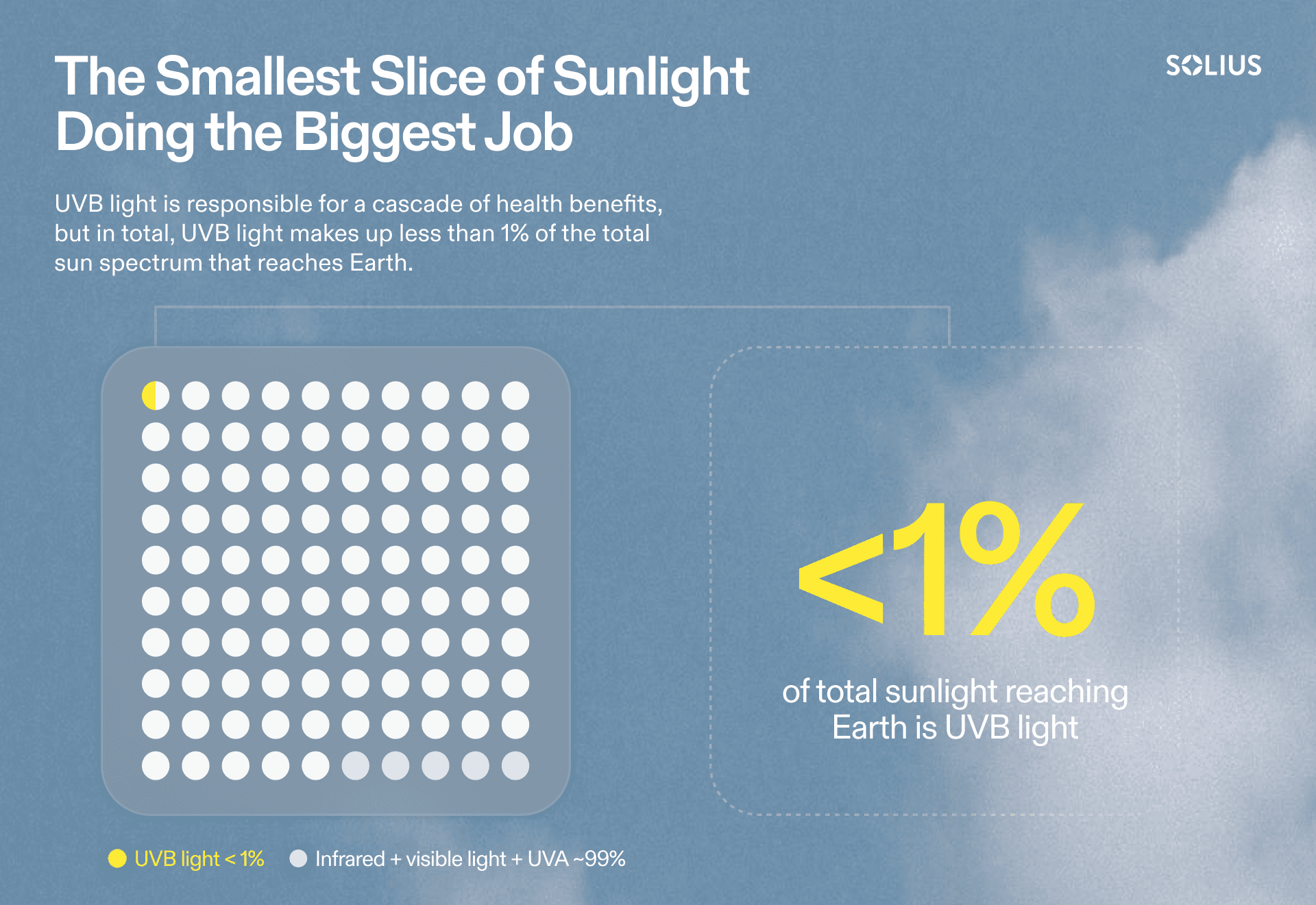
The sun radiates energy across the full electromagnetic spectrum, but Earth’s atmosphere acts as a highly selective filter. Of the total solar energy that strikes the top of the atmosphere, approximately 50% is infrared, 40% is visible light, and less than 10% is ultraviolet. Of that UV radiation, roughly 95% is UVA and just 5% is UVB - and even that small fraction is dramatically affected by atmospheric conditions before it reaches the surface.
The ozone layer’s role
The stratospheric ozone layer, located roughly 15 to 35 kilometers above Earth’s surface, is the primary filter for UVB radiation. Ozone molecules absorb UVB photons with particular efficiency, especially at the shorter end of the UVB spectrum. The result is that only wavelengths above approximately 290-295 nm reach sea level in any meaningful quantity — the shorter, more energetic UVB wavelengths are almost entirely blocked.
This is biologically significant: the wavelengths most effective at initiating vitamin D synthesis (around 295–300 nm) sit right at the edge of what the ozone layer transmits. Even small changes in ozone concentration — from seasonal variation, geography, or human-caused depletion — meaningfully alter how much biologically active UVB reaches the surface.
The solar zenith angle
Perhaps the single most important factor governing UVB intensity at ground level is the solar zenith angle — the angle of the sun relative to a point directly overhead. When the sun is low on the horizon, its rays travel through a much thicker slice of atmosphere. That longer path means greater filtering: more ozone to traverse, more opportunities for scattering and absorption.
When the sun is directly overhead (zenith angle of 0°), UVB has the shortest atmospheric path and arrives at maximum intensity. As the sun descends toward the horizon, UVB intensity drops dramatically — far more steeply than visible light. This is why UVB is available only for a few hours around solar noon, even on clear days.
Factors That Determine UVB Exposure
Understanding how much UVB actually reaches a person’s skin on any given day requires accounting for a web of interacting variables. Researchers and dermatologists use the UV Index — a standardized scale developed by the World Health Organization - as a single summary measure of these factors. But the variables behind that index are worth understanding individually.
How does season affect UVB exposure?
The tilt of Earth’s axis means that the angle at which sunlight strikes a given location changes dramatically throughout the year. In summer, the sun is higher in the sky, solar zenith angles are smaller, and UVB arrives with relatively little atmospheric attenuation. In winter, the sun sits lower on the horizon for all daylight hours, and UVB must travel through a much thicker atmosphere to reach the surface.
At latitudes above approximately 35-37° north or south - which includes most of the continental United States, all of Canada, and most of Europe - UVB is insufficient for meaningful vitamin D synthesis for some portion of the year. In northern cities like Boston, Seattle, Minneapolis, or London, this “vitamin D winter” can last from October through March or April. During these months, even outdoor exposure at midday produces little to no cutaneous vitamin D synthesis.
A useful rule of thumb comes from the UV Index itself: A UV Index below 3 generally does not provide enough UVB for meaningful vitamin D synthesis, regardless of how long someone stays outside. Research published by the GrassrootsHealth Nutrient Research Institute has mapped these seasonal UVB patterns extensively, demonstrating stark reductions in population vitamin D levels that track closely with UVB availability through the year.
How does latitude affect UVB?
Latitude determines the baseline solar zenith angle and therefore the baseline UVB environment. Near the equator, the sun is nearly overhead year-round, and UVB is available throughout the day, in all seasons. As latitude increases — moving toward the poles — the sun angle decreases, the atmospheric path lengthens, and UVB availability drops.
Studies consistently show that populations living closer to the equator have higher average vitamin D levels and lower rates of conditions associated with lower UVB exposure, including multiple sclerosis, certain cancers, and seasonal affective disorder. The UVB-latitude relationship is one of the strongest natural experiments in nutritional epidemiology.
Keep in mind: If your shadow is longer than your height, the solar zenith angle is greater than 45°, and UVB intensity is likely insufficient for meaningful skin synthesis — regardless of how bright and sunny the day appears.
How does altitude affect UVB?
At higher altitudes, the atmosphere is thinner and there is less air and ozone for UVB light to pass through. UVB intensity increases approximately 10% for every 1,000 meters of elevation gain, and UVA intensity increases as well. This is why mountain climbers and skiers face substantial UV exposure - and significant sunburn risk - even in cold conditions or at high latitudes.
The increase in UVB at altitude also has implications for vitamin D synthesis: populations living at high elevation tend to have higher sun-generated vitamin D production.
How does weather and cloud cover affect UVB?
Cloud cover is one of the most variable and least intuitive factors in UVB delivery. Thick cloud cover can reduce UVB by 70–90%. Light or scattered cloud cover has a more modest effect - reducing UVB by roughly 20–40% - and some studies have shown that broken cloud cover can actually briefly increase UVB at ground level due to reflection off cloud edges.
Importantly, visible brightness is a poor proxy for UVB. An overcast day can still feel bright and warm - the visible and infrared portions of sunlight pass through clouds relatively well - while UVB is nearly eliminated. This disconnect misleads people into thinking they are getting meaningful sun exposure when they are not.
Pollution and particulate matter in the atmosphere similarly reduce UVB. Urban air quality, smoke from wildfires, and industrial haze all attenuate the UVB reaching ground level, adding another layer of deficit for city dwellers.
Surface area of skin exposed
For the purpose of UVB-driven vitamin D synthesis, the amount of skin exposed matters enormously. The body’s capacity to produce previtamin D3 from UVB is directly proportional to the surface area of skin receiving adequate irradiance.
Whole-body exposure in a swimsuit during peak summer sun can produce the equivalent of 10,000–25,000 IU of vitamin D within 15–20 minutes for a light-skinned individual. That same amount of sun on just the face and hands - the surface area typical of everyday outdoor activity - would generate a fraction of that amount, often under 400 IU.
How skin tone affects UVB absorption
Skin tone also plays a fundamental role. Melanin, the pigment responsible for skin color, acts as a natural UV filter. Darker skin tones require significantly longer UVB exposure to produce equivalent amounts of vitamin D compared to lighter skin tones - sometimes three to five times as long. This biological reality means that individuals with darker skin who live at higher latitudes are at substantially elevated risk of vitamin D deficiency.
Why Getting Enough UVB Naturally Is So Difficult
Does window glass block UVB?
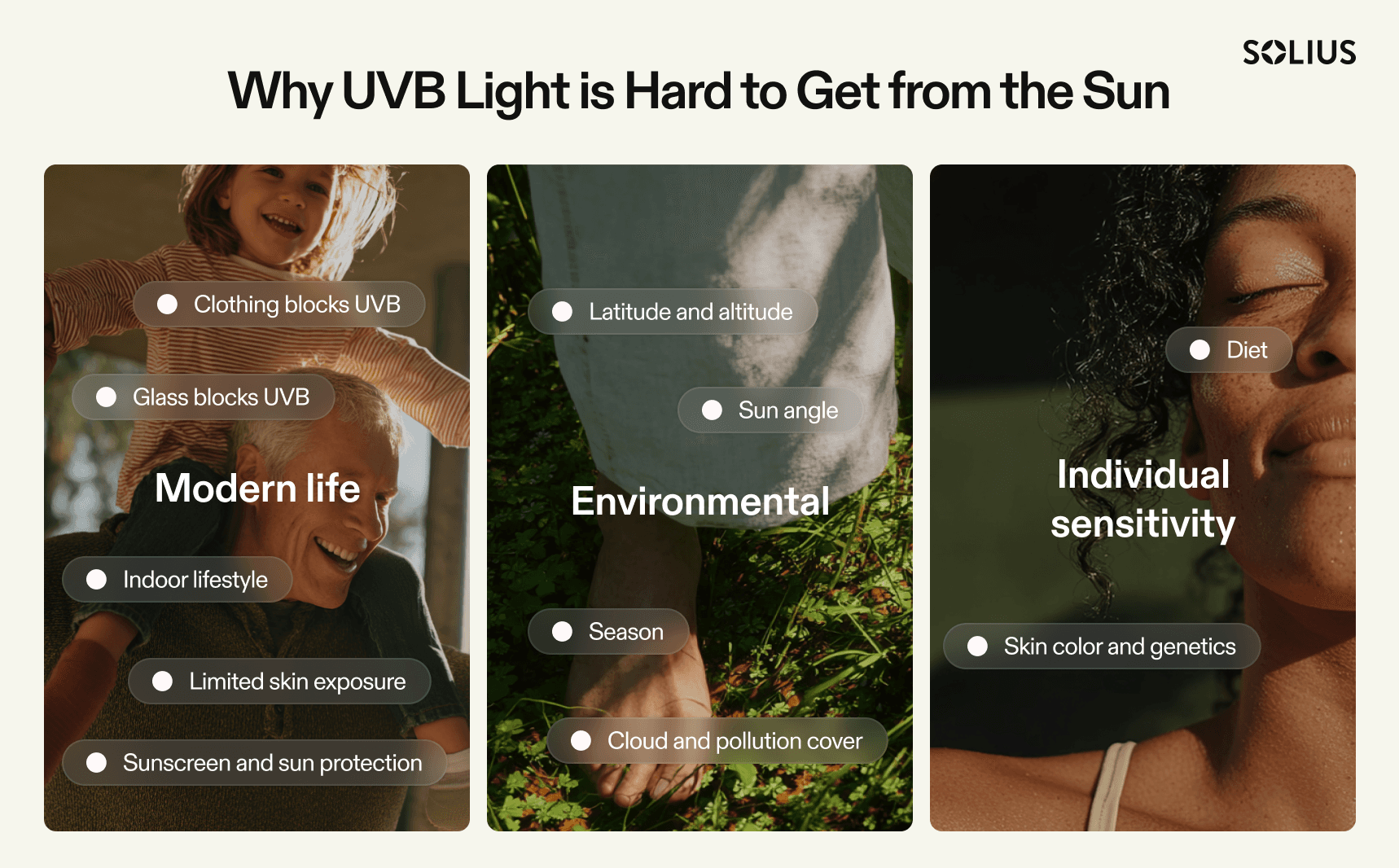
Standard window glass - both residential and automotive - blocks virtually all UVB radiation. Glass transmits visible light and some infrared freely, which is why sunlight through a window can feel warm and bright. But the glass absorbs UVB, preventing it from reaching skin indoors.
This has significant implications for the modern lifestyle. The majority of people in developed countries spend 90% or more of their time indoors or in vehicles. Even individuals who work near windows or in glass-walled offices receive essentially no UVB during those hours, regardless of how sunny it is outside.
Some specialty glass products are manufactured to transmit UV, and certain plastics (like acrylic) pass UVB more readily than glass, but these are not common in everyday architecture.
Does clothing block UVB?
Fabric blocks UVB with varying effectiveness depending on weave density, fiber type, and color. A standard white cotton T-shirt provides an ultraviolet protection factor (UPF) of roughly 15-50 depending on thickness and weave. Dark, tightly woven fabrics can block UVB almost entirely.
The practical consequence: arms, legs, and torso - which together represent the majority of skin surface area - are covered by clothing for most people, most of the time. The remaining exposed skin (primarily the face and hands) is a small fraction of total body surface, severely limiting natural UVB-driven vitamin D synthesis in everyday life.
The burning threshold: finding the effective dose
The challenge of natural UVB exposure is not simply that there isn’t enough - it is that the window between “enough to produce vitamin D” and “enough to cause damage” is narrower than commonly appreciated, and varies significantly from person to person.
The concept of the Minimal Erythemal Dose (MED) describes the smallest UVB exposure that produces detectable redness in skin 24 hours after exposure. Dermatologists have long used MED as a dosing unit for phototherapy, and it serves as a useful reference point for natural exposure as well.
Research suggests that approximately 25–50% of one MED is sufficient to drive robust cutaneous vitamin D synthesis - meaning the exposure needed for vitamin D production is well below the threshold for burning. For a fair-skinned individual at peak summer sun, that might mean 5–10 minutes. For a darker-skinned person, it might mean 30–60 minutes. The challenge is that most people have no reliable way to know where that threshold lies for their individual skin at any given time of day and year.
Sunscreen effectively blocks UVB — SPF 15 reduces UVB transmission by approximately 93%, and SPF 30 by roughly 97%. While sunscreen provides important protection against prolonged UV exposure, its use also eliminates the primary mechanism of sun-driven vitamin D synthesis.
Key insight: The evidence strongly suggests that brief, unprotected midday sun exposure - short of burning - is beneficial for most people. The difficulty lies in the fact that the optimal dose is highly individual, time-dependent, season-dependent, and location-dependent, making it impractical for much of the world’s population to get consistent, adequate natural UVB exposure, and nearly impossible to do so without risking overexposure.
Understanding the science of UVB is the first step toward making informed decisions about your health. For people who can’t consistently access enough natural UVB because of latitude, season, work, or lifestyle, technologies like Solius are designed to help bridge that gap by delivering controlled UVB exposure in a way that’s grounded in the same scientific principles that have guided light therapy for decades. You should consult with your medical provider to see what’s right for you.
Editorial Notes
This article is intended for general informational purposes and does not constitute medical advice. Consult a qualified healthcare provider before making changes to your supplement regimen or sun exposure practices, particularly if you have a medical condition or take medications that may affect vitamin D metabolism.


