


Table of Contents
You’ve heard about the benefits of sunlight before, but did you know they go beyond vitamin D? When modern life systematically prevents you from getting enough rays, there are ways to increase your exposure and gain the health benefits of the sun.
As a Midwesterner living in the Chicagoland area, fall and wintertime almost always mean my mood will drop, I’ll feel more lethargic, and when I see my doctor, my labs will show I’m deficient in vitamin D. In fact, my last two visits to my primary care doctor included an after-visit message from her notifying me that my vitamin D levels were low. While vitamin D supplements are a store away, they don’t always solve the problem, and this got me thinking about what sunlight does to the body beyond giving it vitamin D.
By the end of this article, you’ll understand what sunlight does to your body, how much you need, and what to do when you can’t get enough.
What Happens in Your Body When Sunlight Hits Your Skin?
When ultraviolet B (UVB) rays reach skin, the cholesterol-like molecule 7-dehydrocholesterol converts into previtamin D3. Body heat reshapes this into vitamin D3 that travels to the liver and kidneys, becoming calcitriol, which supports calcium absorption, bone health, and immune function. UV exposure has been investigated for potential effects on the gut microbiome and blood pressure, although the clinical significance of these effects remains uncertain. UVB rays trigger endorphins for mood while sunlight hitting your eyes syncs your circadian clock, regulating sleep.
Controlled UVB phototherapy that is medically supervised with specific wavelengths of UVB light also has strong clinical evidence for psoriasis, eczema, and vitiligo. This does not include unprotected tanning.
Vitamin D — The Mechanism Everyone Knows
It’s well-known that vitamin D helps the body in many ways. “Basically, it’s needed from inception until death,” says Dr. Michael Holick, MD, PhD, leading researcher on vitamin D. “Every tissue and cell in your body has a vitamin D receptor, and they’re there for a reason.”
Dr. Holick explains the science behind sunlight and vitamin D. In your skin, 7-dehydrocholesterol usually turns into cholesterol, except UVB rays get to it first. The UVB energy hits special bonds in the molecule, splitting open part of its structure and turning it into previtamin D. That previtamin D is unstable, so your body heat causes it to reshape itself into vitamin D.
“And so, what we have shown is that you make previtamin D in your cell membrane. And once it changes structurally to vitamin D, it’s ejected out of the membrane…and then eventually diffuses into the dermal capillary beds,” he says.
Major health benefits of vitamin D throughout life include:
Bone health. Research shows vitamin D plays an important role in how efficiently your intestines absorb calcium, which is a process that matters for building strong bones during growth, maintaining bone density in adulthood, and helping prevent osteoporosis later in life.
Immune regulation. Studies have found that vitamin D has immunomodulatory effects on both innate and adaptive immune responses.
Reduced risk of advanced cancer. A secondary analysis of the randomized, placebo-controlled VITAL trial (of 25,871 adults taking 2000 IU/day of vitamin D3) found a lower incidence of advanced cancer with vitamin D supplementation, particularly among participants without overweight or obesity. However, the trial's primary analysis did not find a significant reduction in overall cancer incidence.
Vitamin D also improves birth outcomes by reducing risk for pre-eclampsia, premature births, wheezing disorders, and dental decay in first teeth, Dr. Holick says. “It has important implications for both mom and fetus for fetal development and early in life,” he adds.
Despite the benefits of vitamin D, vitamin D supplementation has challenges that make it hard to have one dose that’s best for everyone. For instance, recent research shows that people with high body mass index (BMI) typically require higher doses of vitamin D supplementation to correct deficiency and that those with high trunk fat need high doses of vitamin D to get high enough levels.
Additionally, a 2026 paper in the European Journal of Endocrinology that analyzed adult serum 25(OH)D of patients at a Barcelona tertiary hospital found that broader testing of vitamin D deficiency detects more people below arbitrary thresholds, prompting supplementation, follow-up testing, and a population-wide upward shift in vitamin D levels. This resulted in toxicity cases often linked to dosing errors, self-medication, or defective supplements causing hypercalcemia and kidney complications.
Other research found that variants in the vitamin D receptor gene can modify how people respond to vitamin D supplementation. This means two people taking the same dose may end up with different blood levels, making a one-size-fits-all dosing guideline difficult.
Sunlight also produces biological effects independent of vitamin D synthesis, although the clinical significance of many of these pathways remains under investigation.
What Sunlight Does That Vitamin D Supplements Can't
While supplements can increase the level of vitamin D in your system, the benefits of sun exposure go beyond what a vitamin D pill can provide. Sunlight:
Mobilizes nitric oxide pathway: In a study conducted at Edinburgh University, researchers hypothesized that exposure to UVA may mobilize nitrogen oxides from cutaneous stores to the circulation to lower blood pressure and cardiovascular mortality. Other research related to sunlight and blood pressure showed that in people with hemodialysis (a treatment for kidney failure), in addition to environmental temperature, incident solar UV radiation was associated with lower systolic blood pressure and that UVB was more powerful than UVA for lowering blood pressure. Researchers concluded that this raises the possibility that insufficient sunlight is a risk factor for hypertension even in the general population.
May influence the gut microbiome balance and gut integrity: When UVB light hits your skin, vitamin D is produced and influences gut health by targeting the intestinal epithelial barrier, gut immunity, and gut microbiota. Additionally, UVB alters gut microbiome composition and influences short-chain fatty acid production, which can transport from intestine to skin, binding receptors on skin cells to influence tissue metabolism and skin barrier function.
Releases endorphins: One study measured mood outcome based on 11 healthy women who received full-body narrowband UVB exposures across four afternoons, with mood, β-endorphin, cortisol, IL-6, and vitamin D tracked daily. Mood improved significantly over the five days following exposure, with a stronger effect in people with an evening chronotype, a biological preference to sleep later, wake up later, and reach peak energy levels in the afternoon or evening.
Regulates Alpha-MSH and CGRP: Research shows that UVB exposure can activate POMC/α-MSH signaling in the skin, contributing to pigmentation and local signaling effects. Alpha-MSH also alters immune cell function through a distinct receptor pathway, separate from vitamin D's immune effects.
Mood, Serotonin, and Seasonal Depression
Sunlight helps with mood and depression in a few ways.
Bright visible light exposure reduces serotonin transporter binding/activity, which can increase available synaptic serotonin. In one study, researchers compared 73 drug-free people with Seasonal Affective Disorder (SAD) to 70 healthy individuals. They measured serotonin transporter (SERT) function in platelets at three different points--baseline (winter depression), after 4 weeks of bright light therapy, and in natural summer remission. Researchers found that during winter depression, the serotonin transporter was working harder/faster and pulling more serotonin back out of the synapse. This correlates with the notion that low synaptic serotonin contributes to depression.
Light therapy can help SAD. A meta-analysis that looked at clinical trials which tested bright light therapy (BLT) via light box or light visors against dim light or sham placebo conditions, found that BLT was significantly superior to placebo. In a paper published in PNAS, researchers found that low doses of UVB stimulate serotonin production and suppress production of dopamine, which is a natural inhibitor of serotonin synthesis. Hence, this suggests potential for increased serotonin accumulation in the body.
Reduced daylight hours can connect to serotonin drops, which can increase risk of SAD, especially at northern latitudes. Research shows that in people living with SAD, their brains show reduced serotonin levels, and total sunlight exposure may be connected to molecules involved in regulating serotonin, so functioning is impaired at fewer daylight hours. Additionally, a systematic review and meta-analysis found that higher latitude is significantly associated with increased prevalence of SAD and Subsyndromal Seasonal Affective Disorder (SSAD), also called “winter blues.” Researchers found that for each 1-degree increase in latitude, SAD prevalence rose by 0.2 percentage points, and SSAD rose by 0.32 percentage points.
Sleep — How Sunlight Sets Your Internal Clock
Sunlight and sleep are connected. The circadian clock needs a daily light signal to stay calibrated. Sunshine in the morning calibrates the circadian rhythm, making it easier to fall asleep at night.
“Bright sunlight will suppress your melatonin and keep you awake,” says Dr. Holick. Morning light also reinforces circadian signaling and promotes daytime alertness.
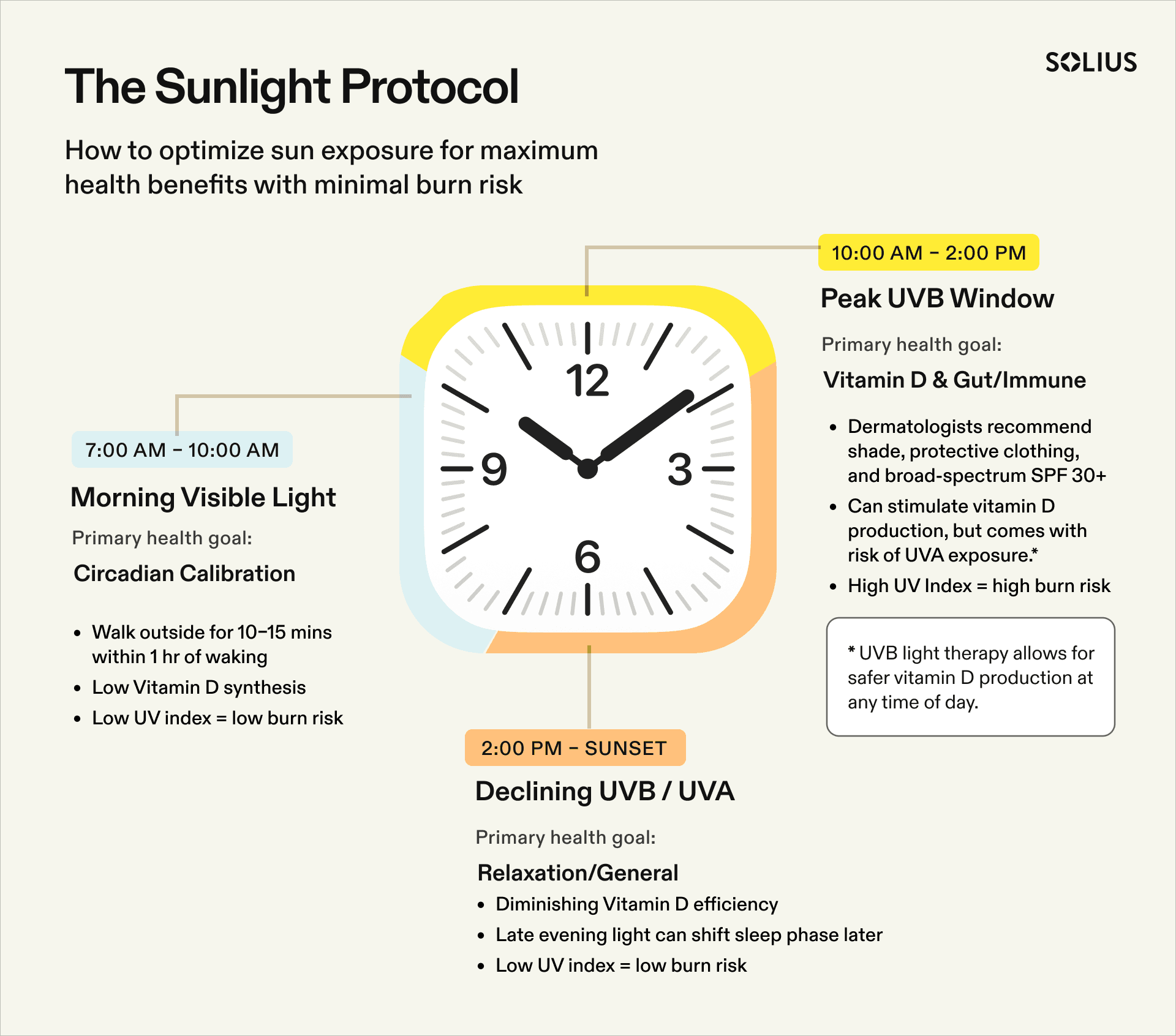
Best timing for circadian benefit is to get bright outdoor light within 1 hour of waking up.
Getting bright light in the evening causes a phase delay that makes you more sleepy later in the night and more likely to wake up later in the morning. For instance, light in the evening that is obtained about 2 hours before and after usual bedtime, can shift the circadian system about 2 hours later per day.
For shift and indoor workers who aren’t able to get morning outdoor light, they risk circadian drift.
How Much Sunlight Do You Actually Need Per Day for Overall Health Benefits?
How much sunlight you need per day will vary per person, and Dr. Holick says giving a numeric answer isn’t realistic. “Time of day, season, latitude, degree of skin, pigmentation all matter,” he says. “For me, out on Cape Cod, at noon time in June, I know I’m going to get a sunburn after 30 minutes, so I would go out for about 10 to 15 minutes.”
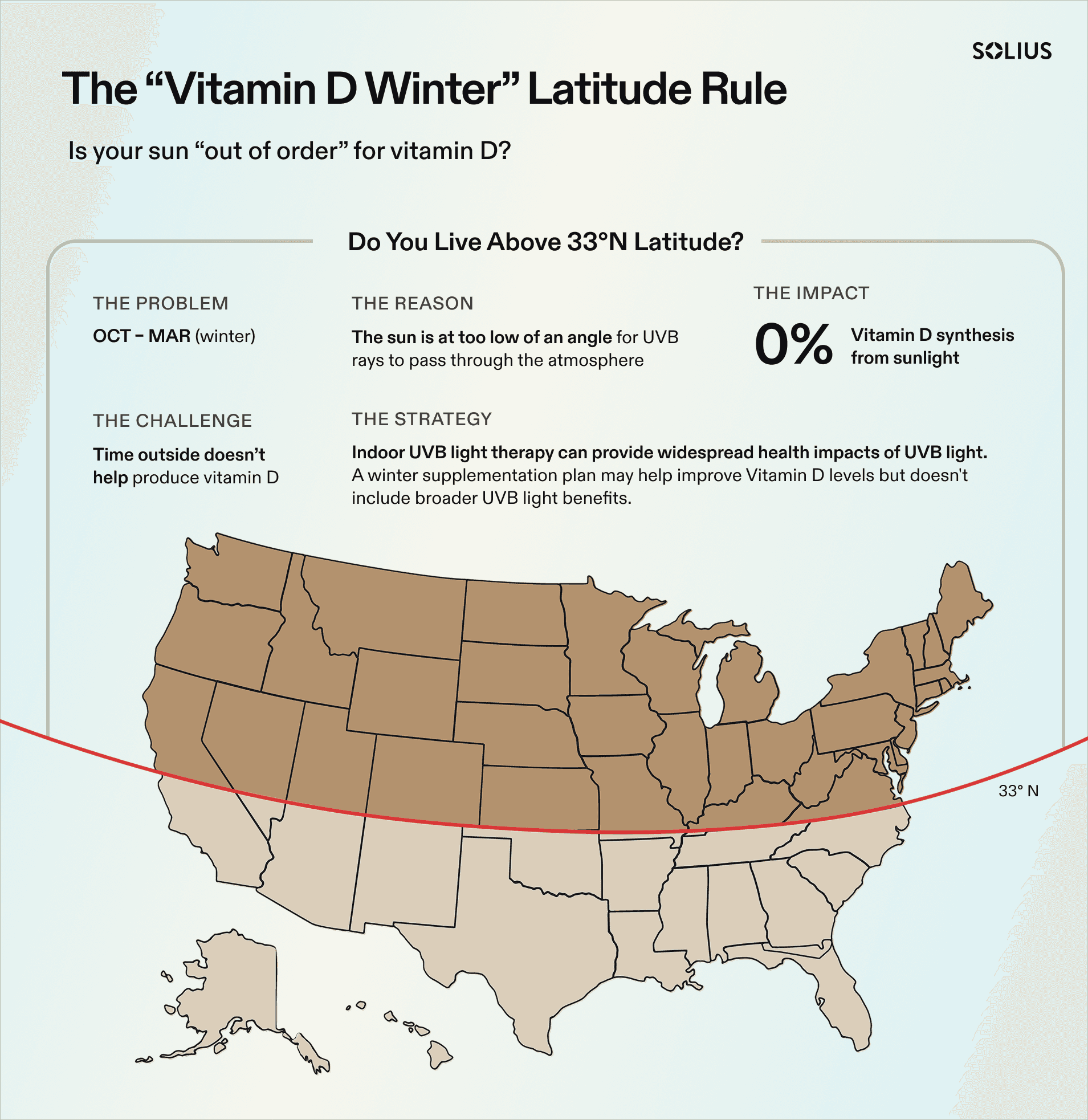
UV index, cloud cover, and sunscreen all modify the output, too. For instance, in Boston, Chicago, or Edinburgh from November through February, the sun sits at too low an angle for midday UVB to produce meaningful vitamin D synthesis, no matter how long you're outside. Additionally, using sunburn as the upper limit signal is not a fixed time count.
What Time of Day Is Best for Sunlight Exposure?
Sun exposure provides different benefits at different times of day. UV index is a useful signal for knowing when UVB is actually present.
Morning from 7–10 am is best for circadian entrainment and has a lower UV index, which means lower burn risk. However, this timeframe is not optimal for vitamin D synthesis.
Midday from 10 am–2 pm has the highest UV. However, this is also is the timeframe when you’re at higher risk for burning with prolonged exposure, which is exactly the tradeoff therapy like Solius is built to avoid: It delivers a controlled, personalized UVB dose without requiring you to time or risk unprotected midday sun exposure.
The afternoon is a time when UVB is declining, circadian benefit reduces, and vitamin D return diminishes.
If you’re unable to get optimal sunlight, consider the following:
Get daily light exposure by going outside for 10 minutes within 1 hour of waking. Keep your eyes open to outdoor brightness. During lunchtime, take a brief outdoor break aiming for midday. Even 5 to 10 minutes of sunlight on the skin in the summer is effective.
Follow a vitamin D strategy during the winter. If you live in an area above 33°N latitude , consistent meaningful UVB ansynthesis from sunlight is effectively impossible for up to 6 months of the year, from October through March. Finding ways to proactively increase vitamin D levels is necessary.
Obtain UVB light therapy if you aren’t able to absorb supplements reliably, or if you want a safer option that delivers a personalized UVB dose without unprotected midday sun exposure. A UVB device can deliver controlled UVB exposure; it does not reproduce the broader biological effects of sunlight.
When Sunlight Becomes Harmful
Although sunlight is good for you, balancing harm with the benefits of sunlight is important. Ultraviolet radiation (UVR) exposure is the main risk factor for melanoma, the most serious type of skin cancer. UVA makes up a majority of the surface solar UVR and most sun exposure that reaches the skin comes from UVA rays, not UVB. UVA reaches deeper skin layers than UVB, is mostly what tanning beds emit, and cuts through sunscreen and glass more easily than UVB does. One study evaluating how UVA and UVB relate to melanoma risk independently of one another highlights that not all UV light is the same, and UVA may carry greater risk.
While prolonged unprotected exposure to sunlight when the UV index is 3+ can put you at risk, sunscreen reduces UVB exposure and therefore can reduce cutaneous vitamin D synthesis under controlled conditions. Although it’s important to note that typical sunscreen use has not consistently been shown to cause vitamin D deficiency overall.
Still, it can be hard to find the right balance of getting the health benefits of the sun while also minimizing the risks. If you burn too easily without sunscreen during times of day that are most beneficial to getting UVB light exposure, UVB light therapy like Solius is a great option.
Keep in mind that skin cancer risk depends on cumulative UV dose as well as exposure pattern; intermittent intense exposure and sunburn are particularly important risk factors for melanoma. In other words, moderate intentional sun exposure is categorically different from chronic occupational overexposure or tanning bed use. In Rowan Jacobsen’s book, “In Defense of Sunlight,” he discusses how people who are indoor office workers have higher risk of skin cancer from intense periodic sun exposure that result in burns while outdoor workers with more exposure but less burns have lower rates of skin cancer.
“There’s no question excessive exposure to sunlight increases risk for a non-melanoma skin cancer, which is easy to detect and easy to treat,” says Dr. Holick. He adds that sunburning experiences as a child and young adult markedly increase that risk, and that people with a large number of moles on their body, those with fair skin or naturally red hair, and people with a personal or family history of skin cancer, are also at increased risk for melanoma.
Additionally, some medications can increase photosensitivity including certain antibiotics, retinoids, and NSAIDs. People with sensitivities or allergies to light (photodermatitis) need to also take precautions.
The Bottom Line
Sunlight is not just a vitamin D delivery mechanism, it’s a multi-pathway biological signal that modern indoor life systematically deprives us of. The research on nitric oxide, endorphins, gut health, circadian regulation, and sunlight’s relationship to the immune system shows that vitamin D supplements address only one downstream effect of sun deprivation while leaving the rest unaddressed. But sunlight itself is hard to dose precisely because intensity shifts by season, latitude, time of day, and skin tone, and the pathways involved respond to different wavelengths at different times.
Understanding what sunlight actually does and which wavelength does which job is the prerequisite for building a protocol that matches your needs. One thing is for sure; light therapy offers a more complete strategy for replicating year-round sun health benefits.
Frequently Asked Questions (FAQs)
Does sunlight through a window count?
You can get some UV rays through a window, however, standard windows in cars, homes, and offices block most UVB rays. If your goal is to get vitamin D, sitting by a window won’t do the trick as your skin needs to be exposed to UVB rays. Standard windows don’t block UVA rays, though, so you will be at risk of UVA exposure with little health benefit.
Can you get too much sunlight?
Yes. While sunlight offers many health benefits, it can be hard to dose precisely because intensity shifts by season, latitude, time of day, and skin tone, and the pathways involved respond to different wavelengths at different times of day. Most people can benefit from light therapy that offers a more complete strategy for replicating year-round sun health benefits with minimal risk.
What are the mental health benefits of sunlight?
Sunlight can help with mood and Seasonal Affective Disorder (SAD) by acting on endorphin release and serotonin activity and production. Bright light therapy can improve SAD, primarily through retinal effects on circadian and neurobiological pathways. A meta-analysis that looked at clinical trials which tested bright light therapy (BLT) via light box or light visors against dim light or sham placebo conditions, found that BLT was significantly superior to placebo.
Editorial Notes
This article is intended for general informational purposes and does not constitute medical advice. Consult a qualified healthcare provider before making changes to your supplement regimen or sun exposure practices, particularly if you have a medical condition or take medications that may affect vitamin D metabolism.


