Doctor with Solius device

Medical
professionals

Shareable material

Digital resources to share with your patients. Contact Solius if you would like printed copies.

Digital copies are available below. Contact Solius if you would like printed copies.

Download the Solius app

Available on the Apple App Store and Google Play Store

Solius user manual

Everything you need to know before starting Solius therapy

Solius overview

A two-page introduction to the technology and the health benefits of UVB light

Solius FAQ

Answers to the questions physicians and patients ask most

Meet Solius

A quick-reference card covering what Solius is and the health benefits of UVB light

Get started with Solius

A quick-reference card on how patients download the app, create an account, and begin therapy

Talking to patients about Solius

Key facts for healthcare professionals recommending Solius.

What is Solius?

Solius is the only FDA-cleared personalized UVB light therapy, which isolates a precise wavelength of the sun and delivers it in a dose tailored to your skin. With just a few minutes per week, Solius is a powerful ritual that unlocks systemic health benefits.

What problem does Solius solve?

Our bodies need UVB light, and the sun is the only natural source. But sunlight doesn’t deliver it cleanly — UVB light arrives bundled with UVA, the wavelength most responsible for cellular damage — or with any way to control dose. Supplements can support vitamin D, but they can’t replicate the broader biological response to sunlight. With Solius, you can access the benefits of UVB light without the risks of unfiltered sunlight.

Sunlight is a foundational pillar of health

Alongside sleep, diet, and exercise, sunlight is essential for human health and longevity. Solius isolates a precise wavelength of UVB light to safely unlock systemic health benefits, redefining our relationship to the sun.

New technology built on proven biology

UVB light has been used for healing for more than 120 years, with extensive research linking it to increased longevity and whole-body health. The biology isn’t new—the technology is. Solius is the only company making UVB light safe and easy to access: FDA-cleared, no prescription needed, with a dose personalized to you.

Personalized dosing

From fair to dark skin, our sunlight needs vary. No two people absorb light the same way. Solius analyzes your skin in seconds, calculating the optimal dose of UVB light for your body.

UVB light has benefits beyond vitamin D

Beyond stimulating your body’s natural vitamin D production, UVB light fuels cognitive function, cardiovascular vitality, and gut health, while enhancing immunity, bone density, and energy. Unlike supplements, Solius supports your overall health, with benefits compounding over time.

Clinical research

Peer-reviewed evidence on sunlight, UVB light, and vitamin D.

Featured

Brain & Mood

Gut

Bones

Heart

Performance & Recovery

Wellness & Longevity

Women’s Health

Skin

Featured research

Emerging research in leading medical and scientific journals suggests that targeted UVB light exposure may influence biological pathways related to vitamin D metabolism, immune regulation, and systemic health. Solius is designed around this growing body of evidence.

  • Published in leading peer-reviewed journals.

  • Grounded in photobiology and clinical nutrition research.

  • Based on research in sun exposure biology, endocrinology, and epidemiology.

  • Supported by clinical and population-level evidence on UVB light and vitamin D.

Learn More

Selected findings

This mouse study tested whether Solius UVB light therapy could influence gut health, comparing vitamin D sufficient and deficient mice given either a single exposure or six repeated exposures over 14 days. Repeated exposures significantly increased vitamin D levels to match sufficient-diet controls without injury to the skin. Notably, repeated therapy significantly altered gut microbiota composition and fecal metabolome, especially in vitamin D–deficient mice, enriching bacteria linked to metabolic health and leanness while increasing beneficial compounds like short-chain fatty acids, bile acid derivatives, and tryptophan metabolites. Pathway analysis further suggested UVB exposure inhibited oxidative stress and tumor-related signaling while activating anti-inflammatory pathways. Serum metabolomic changes were much smaller than fecal changes, suggesting the effects were concentrated in the gut rather than just reflecting systemic responses. Overall, the study concludes Solius UVB therapy can be safely used to reshape gut microbial and metabolic profiles in a way that promotes gut health.

Featured Research

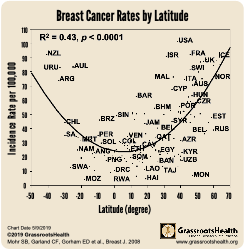
Populations in lower-sun latitudes show higher rates of multiple chronic diseases, largely attributed to reduced UVB-driven vitamin D synthesis and other non-vitamin-D biological pathways.

Featured Research

This randomized, placebo-controlled, clinical trial showed that the SOLIUS system effectively increased 25(OH)D concentrations in individuals with vitamin D deficiency or insufficiency, offering a safe solution for improving vitamin D status. The treatment group showed a significant increase in serum 25(OH)D concentrations, with an average increase of 10.2 ng/ml (p<0.01), compared to a decrease of 2.3 ng/ml in the control group.

Featured Research

This large UK Biobank study of 419,007 adults found that higher habitual UV exposure was associated with significantly lower all-cause mortality, cardiovascular mortality, and non-skin cancer mortality, with clear dose-response trends. Critically, higher UV exposure showed no meaningful increase in skin cancer mortality. Counterfactual modeling quantified the trade-off directly: shifting the entire population to high UV exposure would prevent approximately 5,000 deaths from cardiovascular disease and internal cancers at the cost of only a few dozen additional skin cancer deaths - a net survival benefit ratio of roughly 100 to 1. Proteomic analysis in a 44,712-person subcohort identified the biological mechanisms as operating primarily through three non-vitamin D pathways - immunoregulatory, mucosal-barrier, and cardiorenal-neuroendocrine - confirming that the mortality benefits of UV exposure cannot be replicated by oral vitamin D supplementation. The authors conclude that current public health guidance, which frames sunlight primarily as a skin cancer hazard to be avoided, is inconsistent with the weight of evidence and warrants reappraisal. Limitations include the observational design, a White European-only cohort, and preprint status pending peer review. Builds upon this published research:

Featured Research

Featured

Brain & Mood

Gut

Bones

Heart

Performance & Recovery

Wellness & Longevity

Women’s Health

Skin

Featured research

Emerging research in leading medical and scientific journals suggests that targeted UVB light exposure may influence biological pathways related to vitamin D metabolism, immune regulation, and systemic health. Solius is designed around this growing body of evidence.

  • Published in leading peer-reviewed journals.

  • Grounded in photobiology and clinical nutrition research.

  • Based on research in sun exposure biology, endocrinology, and epidemiology.

  • Supported by clinical and population-level evidence on UVB light and vitamin D.

Learn More

Selected findings

This mouse study tested whether Solius UVB light therapy could influence gut health, comparing vitamin D sufficient and deficient mice given either a single exposure or six repeated exposures over 14 days. Repeated exposures significantly increased vitamin D levels to match sufficient-diet controls without injury to the skin. Notably, repeated therapy significantly altered gut microbiota composition and fecal metabolome, especially in vitamin D–deficient mice, enriching bacteria linked to metabolic health and leanness while increasing beneficial compounds like short-chain fatty acids, bile acid derivatives, and tryptophan metabolites. Pathway analysis further suggested UVB exposure inhibited oxidative stress and tumor-related signaling while activating anti-inflammatory pathways. Serum metabolomic changes were much smaller than fecal changes, suggesting the effects were concentrated in the gut rather than just reflecting systemic responses. Overall, the study concludes Solius UVB therapy can be safely used to reshape gut microbial and metabolic profiles in a way that promotes gut health.

Featured Research

Populations in lower-sun latitudes show higher rates of multiple chronic diseases, largely attributed to reduced UVB-driven vitamin D synthesis and other non-vitamin-D biological pathways.

Featured Research

This randomized, placebo-controlled, clinical trial showed that the SOLIUS system effectively increased 25(OH)D concentrations in individuals with vitamin D deficiency or insufficiency, offering a safe solution for improving vitamin D status. The treatment group showed a significant increase in serum 25(OH)D concentrations, with an average increase of 10.2 ng/ml (p<0.01), compared to a decrease of 2.3 ng/ml in the control group.

Featured Research

This large UK Biobank study of 419,007 adults found that higher habitual UV exposure was associated with significantly lower all-cause mortality, cardiovascular mortality, and non-skin cancer mortality, with clear dose-response trends. Critically, higher UV exposure showed no meaningful increase in skin cancer mortality. Counterfactual modeling quantified the trade-off directly: shifting the entire population to high UV exposure would prevent approximately 5,000 deaths from cardiovascular disease and internal cancers at the cost of only a few dozen additional skin cancer deaths - a net survival benefit ratio of roughly 100 to 1. Proteomic analysis in a 44,712-person subcohort identified the biological mechanisms as operating primarily through three non-vitamin D pathways - immunoregulatory, mucosal-barrier, and cardiorenal-neuroendocrine - confirming that the mortality benefits of UV exposure cannot be replicated by oral vitamin D supplementation. The authors conclude that current public health guidance, which frames sunlight primarily as a skin cancer hazard to be avoided, is inconsistent with the weight of evidence and warrants reappraisal. Limitations include the observational design, a White European-only cohort, and preprint status pending peer review. Builds upon this published research:

Featured Research

Featured

Brain & Mood

Gut

Bones

Heart

Performance & Recovery

Wellness & Longevity

Women’s Health

Skin

Featured research

Emerging research in leading medical and scientific journals suggests that targeted UVB light exposure may influence biological pathways related to vitamin D metabolism, immune regulation, and systemic health. Solius is designed around this growing body of evidence.

  • Published in leading peer-reviewed journals.

  • Grounded in photobiology and clinical nutrition research.

  • Based on research in sun exposure biology, endocrinology, and epidemiology.

  • Supported by clinical and population-level evidence on UVB light and vitamin D.

Learn More

Selected findings

Close-up side view of an older woman wearing a zip-up jacket, standing outdoors in a grassy field during warm golden-hour light

Skin-directed Solius UVB light therapy increases vitamin D levels and alters intestinal microbiome and metabolome homeostasis

Frontiers in Microbiology

This mouse study tested whether Solius UVB light therapy could influence gut health, comparing vitamin D sufficient and deficient mice given either a single exposure or six repeated exposures over 14 days. Repeated exposures significantly increased vitamin D levels to match sufficient-diet controls without injury to the skin. Notably, repeated therapy significantly altered gut microbiota composition and fecal metabolome, especially in vitamin D–deficient mice, enriching bacteria linked to metabolic health and leanness while increasing beneficial compounds like short-chain fatty acids, bile acid derivatives, and tryptophan metabolites. Pathway analysis further suggested UVB exposure inhibited oxidative stress and tumor-related signaling while activating anti-inflammatory pathways. Serum metabolomic changes were much smaller than fecal changes, suggesting the effects were concentrated in the gut rather than just reflecting systemic responses. Overall, the study concludes Solius UVB therapy can be safely used to reshape gut microbial and metabolic profiles in a way that promotes gut health.

Featured Research

Close-up side view of an older woman wearing a zip-up jacket, standing outdoors in a grassy field during warm golden-hour light

Higher disease rates in low sun latitudes

Multiple Articles

Populations in lower-sun latitudes show higher rates of multiple chronic diseases, largely attributed to reduced UVB-driven vitamin D synthesis and other non-vitamin-D biological pathways.

Featured Research

Close-up side view of an older woman wearing a zip-up jacket, standing outdoors in a grassy field during warm golden-hour light

Effectiveness of SOLIUS UVB Light System in Enhancing Serum 25-Hydroxyvitamin D Concentrations: A Randomized Controlled Trial

Anticancer Research

This randomized, placebo-controlled, clinical trial showed that the SOLIUS system effectively increased 25(OH)D concentrations in individuals with vitamin D deficiency or insufficiency, offering a safe solution for improving vitamin D status. The treatment group showed a significant increase in serum 25(OH)D concentrations, with an average increase of 10.2 ng/ml (p<0.01), compared to a decrease of 2.3 ng/ml in the control group.

Featured Research

Close-up side view of an older woman wearing a zip-up jacket, standing outdoors in a grassy field during warm golden-hour light

Pre-Print: Risk–benefit balance of habitual ultraviolet exposure for cardiovascular, cancer, and skin cancer mortality

medRxiv

This large UK Biobank study of 419,007 adults found that higher habitual UV exposure was associated with significantly lower all-cause mortality, cardiovascular mortality, and non-skin cancer mortality, with clear dose-response trends. Critically, higher UV exposure showed no meaningful increase in skin cancer mortality. Counterfactual modeling quantified the trade-off directly: shifting the entire population to high UV exposure would prevent approximately 5,000 deaths from cardiovascular disease and internal cancers at the cost of only a few dozen additional skin cancer deaths - a net survival benefit ratio of roughly 100 to 1. Proteomic analysis in a 44,712-person subcohort identified the biological mechanisms as operating primarily through three non-vitamin D pathways - immunoregulatory, mucosal-barrier, and cardiorenal-neuroendocrine - confirming that the mortality benefits of UV exposure cannot be replicated by oral vitamin D supplementation. The authors conclude that current public health guidance, which frames sunlight primarily as a skin cancer hazard to be avoided, is inconsistent with the weight of evidence and warrants reappraisal. Limitations include the observational design, a White European-only cohort, and preprint status pending peer review. Builds upon this published research:

Featured Research

Setup

Setup is simple and straightforward. Therapy preparation is guided by the Solius mobile app. Most users complete setup in under 10 minutes.

01

Man standing in a sunlit, minimalist bathroom, looking at his phone, with a freestanding bathtub, wooden vanity, and soft shadows on beige walls.

Download the Solius mobile app

Get the app from Apple App Store or Google Play Store

Minimalist illustration of a black wall-mounted device shown in a circular frame against a light, patterned background.

Set up account and complete onboarding

In the app, create an account and then follow the prompts on screen to learn more about Solius and how to complete therapy.

02
Minimal dashboard card showing therapy details with next recommended date, previous session date, personalized dose, and options to schedule, view history, or adjust settings

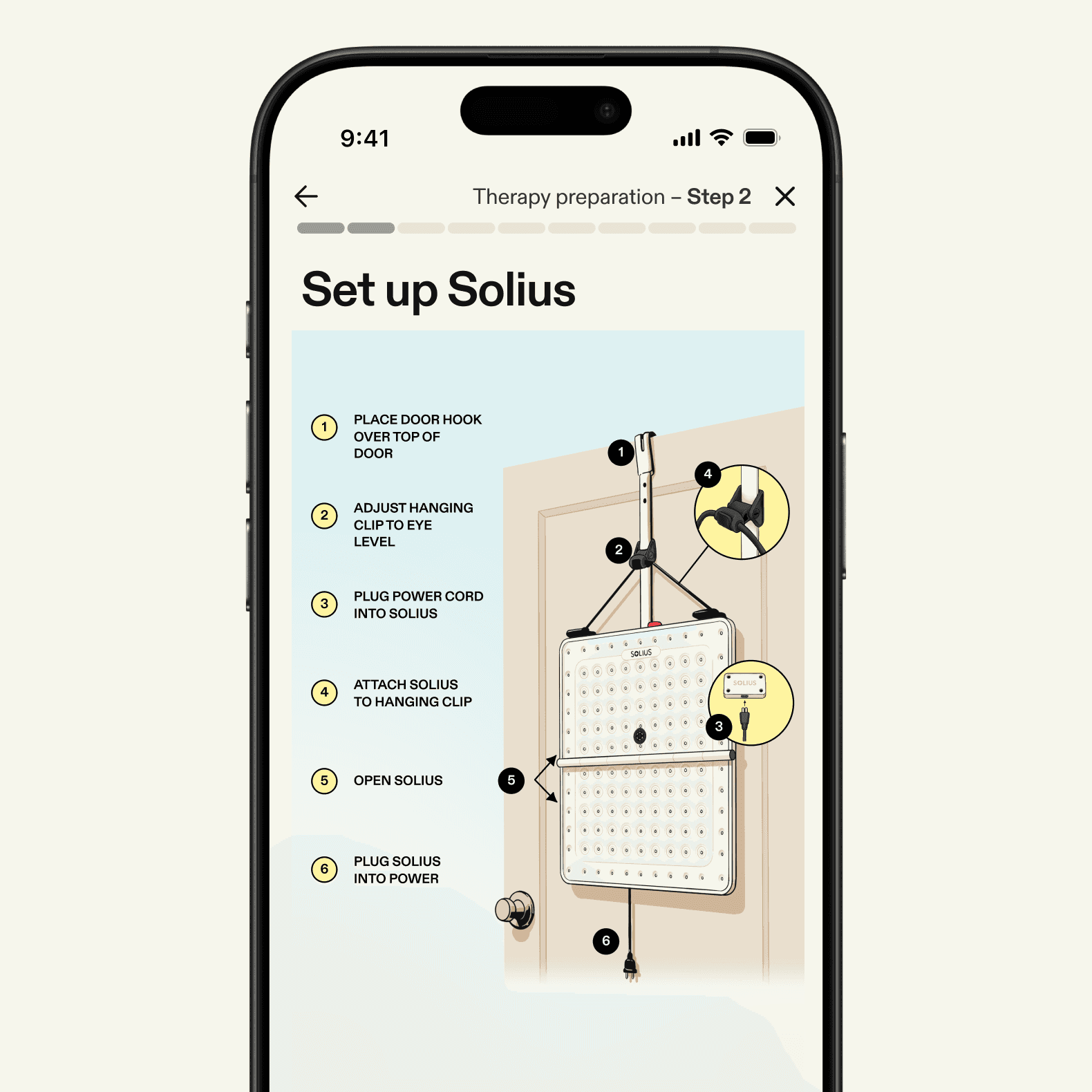
Hang Solius Pro

Follow the instructions in the User Manual to easily hang Solius Pro on any interior door.

03

Therapy

Start and follow your personalized therapy routine.
Minimal dashboard card showing therapy details with next recommended date, previous session date, personalized dose, and options to schedule, view history, or adjust settings

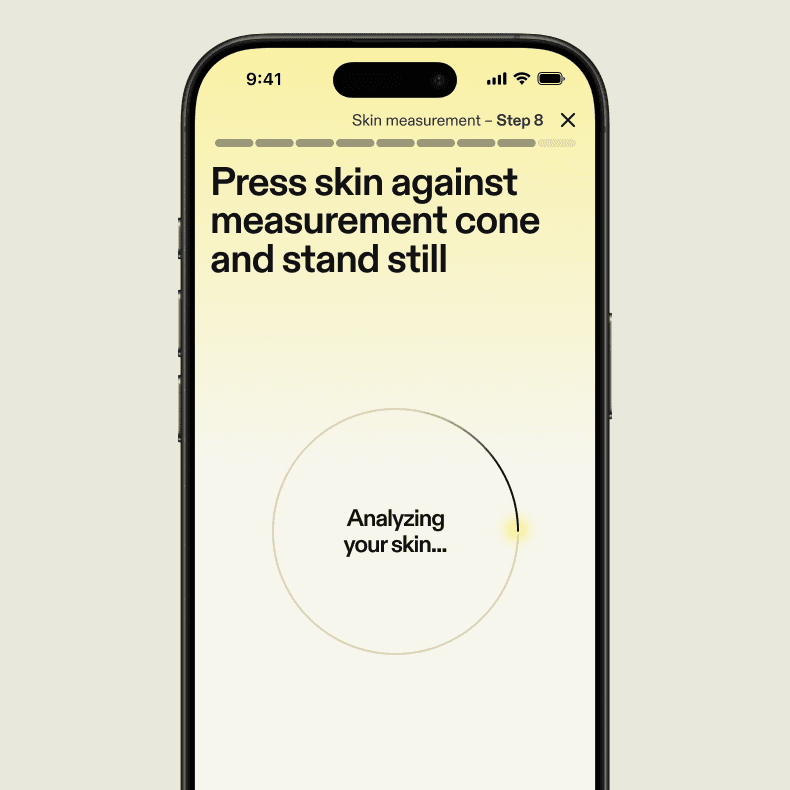
Measure skin for personalized dose

The app will guide you through attaching the skin measurement cone to the device and measuring a clear area of skin on your back. Solius will use this measurement to calculate a personalized dose for your unique skin.

04
Minimal dashboard card showing therapy details with next recommended date, previous session date, personalized dose, and options to schedule, view history, or adjust settings

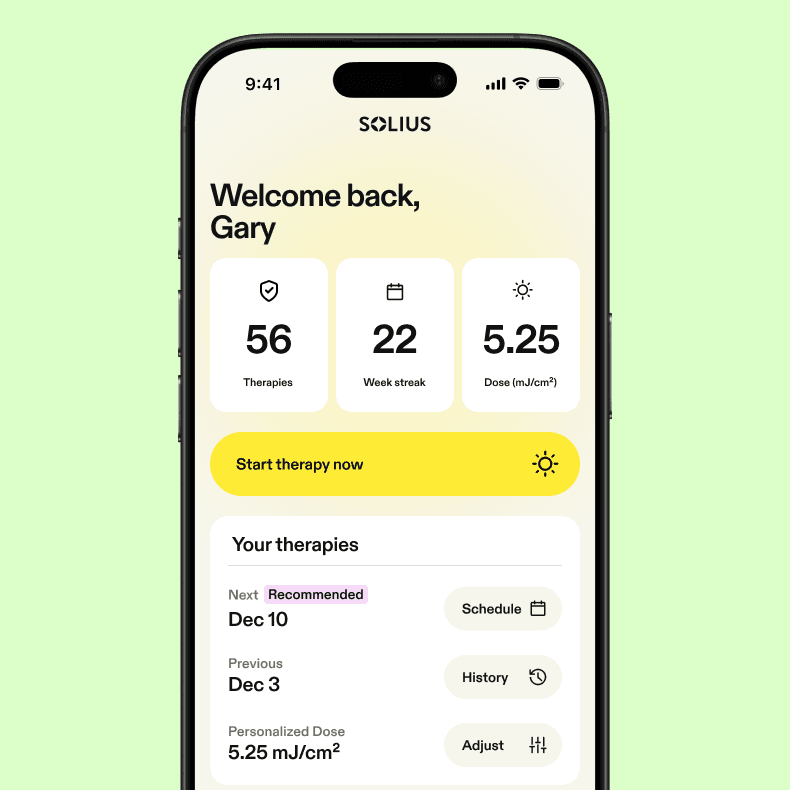
Start your first therapy session

Tap “Start therapy now” on the app Home screen to begin your first therapy.

05
Minimal dashboard card showing therapy details with next recommended date, previous session date, personalized dose, and options to schedule, view history, or adjust settings

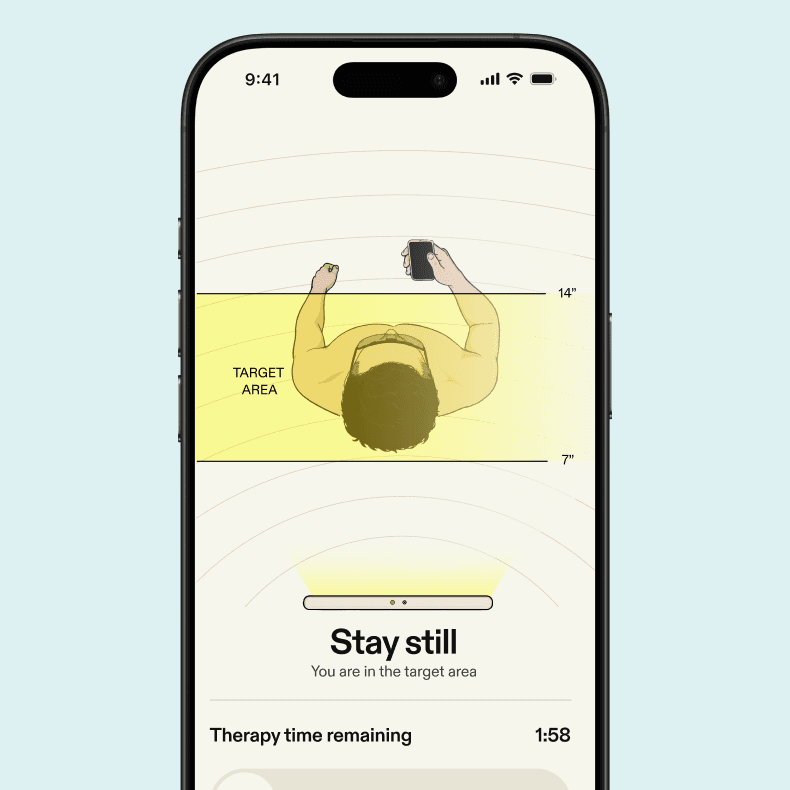
Complete weekly therapy

Put on Solius glasses, align your back towards the light panel, and start therapy. Stand still until your personalized therapy duration is complete. Complete therapy weekly to optimize health benefits.

06

Optimize personal dose

Adjust your personalized dose based on your skin's response to therapy — see what to expect at each step.

Minimal dashboard card showing therapy details with next recommended date, previous session date, personalized dose, and options to schedule, view history, or adjust settings

Report how your skin responds

After each therapy the mobile app will ask if you experienced any skin pinkness, redness or irritation lasting longer than a day. If so, your dose will be lowered automatically.

07

Minimal dashboard card showing therapy details with next recommended date, previous session date, personalized dose, and options to schedule, view history, or adjust settings

Increase your dose

If you did not experience a skin response, you can optionally increase your dose up to 20% at a time to maximize health benefits. You must complete a full therapy between each dose increase.

08

Minimal dashboard card showing therapy details with next recommended date, previous session date, personalized dose, and options to schedule, view history, or adjust settings

Find your maximum dose

When you experience mild skin irritation it is a normal sign you've reached your maximum dose. Your dose will be automatically adjusted down one level to keep future doses optimized for both safety and maximum health benefits. Most people reach their maximum dose within five increases, though individual results vary.

09

Exploded view of a circular electronic device, showing internal components such as casing, rings, circuit boards, and connector separated along a central axis.

Skin sensor technology

Solius uses advanced sensors to measure your skin and determine your optimal dose.

Personalized dosing system

Deliver a dose tailored precisely to your needs to maximize benefits, minimize risk, and redefine how your body experiences the sun.

Validated across every skin type

In FDA-reviewed usability testing conducted by Eurofins Clinical Research Laboratories, 27 users spanning Fitzpatrick skin types I through VI were tested using the Solius dosing system - 100% reported no adverse skin reactions, and no adverse events were observed.
Source: FDA 510(k) Summary, K252960

100%

of users reported no adverse skin reactions during testing

Zero adverse events observed

Accessories and replacements

Wall Mount Hanging System

Not included · View details

Door Hanging System

Included · View details

Solius Protective Eyewear

Included · View details

Skin Measurement Cone

Included · View details

10 ft Detachable Power Cord

Included · View details

Research partners

Scientific and medical advisory board

The Solius Scientific and Medical Advisory Board comprises independent experts who advise on clinical research and provide scientific and medical insight into the safety, effectiveness, and appropriate use of Solius technology.

Sanjiv Chopra, MD
+Read More

Gastroenterology, Hepatology

Sanjiv Chopra, MD

Professor of Medicine, Harvard Medical School Speaker and Author

Shadi Kourosh, MD, MPH
+Read More

Dermatology

Shadi Kourosh, MD, MPH

Associate Professor of Dermatology, Harvard Medical School American Academy of Dermatology Board Member

Roger D. Seheult, MD
+Read More

Pulmonary, Critical Care, Sleep

Roger D. Seheult, MD

Assoc. Clinical Professor, UC Riverside School of Medicine Asst. Clinical Professor, School of Medicine and Allied Health at Loma Linda University Co-founder of MedCram

Ami Bhatt, MD, FACC
+Read More

Cardiology

Ami Bhatt, MD, FACC

Chief Medical Officer, WHOOP Former Inaugural Chair, FDA Digital Health Advisory Committee Former Chief Innovation Officer, American College of Cardiology Former Director of Outpatient Cardiology, Massachusetts General Hospital

Advisor portrait
+Read More

Neurorehabilitation

Daniel Daneshvar, MD, PhD

Chair, Department of Physical Medicine and Rehabilitation, Harvard Medical School and Mass General Brigham

Paolo Cassano, MD, PhD
+Read More

Psychiatry

Paolo Cassano, MD, PhD

Director of Photobiomodulation, Div. Neuropsychiatry, Dept. Psychiatry, Mass General Brigham

Rachele Pojednic, PhD
+Read More

Nutrition and Exercise Physiology

Rachele Pojednic, PhD

Faculty, Stanford University Chief Science Officer, Restore

The Board does not provide medical advice and is free to express views independent of Solius.

Scientific and medical advisory board

The Solius Scientific and Medical Advisory Board comprises independent experts who advise on clinical research and provide scientific and medical insight into the safety, effectiveness, and appropriate use of Solius technology.

Sanjiv Chopra, MD
+Read More

Gastroenterology, Hepatology

Sanjiv Chopra, MD

Professor of Medicine, Harvard Medical School Speaker and Author

Shadi Kourosh, MD, MPH
+Read More

Dermatology

Shadi Kourosh, MD, MPH

Associate Professor of Dermatology, Harvard Medical School American Academy of Dermatology Board Member

Roger D. Seheult, MD
+Read More

Pulmonary, Critical Care, Sleep

Roger D. Seheult, MD

Assoc. Clinical Professor, UC Riverside School of Medicine Asst. Clinical Professor, School of Medicine and Allied Health at Loma Linda University Co-founder of MedCram

Ami Bhatt, MD, FACC
+Read More

Cardiology

Ami Bhatt, MD, FACC

Chief Medical Officer, WHOOP Former Inaugural Chair, FDA Digital Health Advisory Committee Former Chief Innovation Officer, American College of Cardiology Former Director of Outpatient Cardiology, Massachusetts General Hospital

Advisor portrait
+Read More

Neurorehabilitation

Daniel Daneshvar, MD, PhD

Chair, Department of Physical Medicine and Rehabilitation, Harvard Medical School and Mass General Brigham

Paolo Cassano, MD, PhD
+Read More

Psychiatry

Paolo Cassano, MD, PhD

Director of Photobiomodulation, Div. Neuropsychiatry, Dept. Psychiatry, Mass General Brigham

Rachele Pojednic, PhD
+Read More

Nutrition and Exercise Physiology

Rachele Pojednic, PhD

Faculty, Stanford University Chief Science Officer, Restore

The Board does not provide medical advice and is free to express views independent of Solius.

Scientific and medical advisory board

The Solius Scientific and Medical Advisory Board comprises independent experts who advise on clinical research and provide scientific and medical insight into the safety, effectiveness, and appropriate use of Solius technology.

Sanjiv Chopra, MD
+Read More

Gastroenterology, Hepatology

Sanjiv Chopra, MD

Professor of Medicine, Harvard Medical School Speaker and Author

Shadi Kourosh, MD, MPH
+Read More

Dermatology

Shadi Kourosh, MD, MPH

Associate Professor of Dermatology, Harvard Medical School American Academy of Dermatology Board Member

Roger D. Seheult, MD
+Read More

Pulmonary, Critical Care, Sleep

Roger D. Seheult, MD

Assoc. Clinical Professor, UC Riverside School of Medicine Asst. Clinical Professor, School of Medicine and Allied Health at Loma Linda University Co-founder of MedCram

Ami Bhatt, MD, FACC
+Read More

Cardiology

Ami Bhatt, MD, FACC

Chief Medical Officer, WHOOP Former Inaugural Chair, FDA Digital Health Advisory Committee Former Chief Innovation Officer, American College of Cardiology Former Director of Outpatient Cardiology, Massachusetts General Hospital

Advisor portrait
+Read More

Neurorehabilitation

Daniel Daneshvar, MD, PhD

Chair, Department of Physical Medicine and Rehabilitation, Harvard Medical School and Mass General Brigham

Paolo Cassano, MD, PhD
+Read More

Psychiatry

Paolo Cassano, MD, PhD

Director of Photobiomodulation, Div. Neuropsychiatry, Dept. Psychiatry, Mass General Brigham

Rachele Pojednic, PhD
+Read More

Nutrition and Exercise Physiology

Rachele Pojednic, PhD

Faculty, Stanford University Chief Science Officer, Restore

The Board does not provide medical advice and is free to express views independent of Solius.

We are here to help you and your patients

For questions about Solius, or inquiries on behalf of your patients, please reach out and we will respond as soon as possible.

Your patients can also reach us at hello@solius.com.