



Table of Contents
Key takeaway:
UVB phototherapy is an established treatment for psoriasis, eczema, and other skin conditions, usually in-clinic under doctor supervision.
Recent research suggests that UVB light therapy may provide other health benefits as well, supporting the idea that even people without a skin condition can benefit from this treatment.
However, not all light therapy devices are created equal. Type of light, home vs in-clinic, and prescription vs OTC are just some of the factors to consider. Do some research on these devices before purchasing in order to find one that’s appropriate for your health needs.
I can’t be the only one who gets an instant mood boost on the first warm day of spring. There’s something about the sun kissing your skin that feels healthy — and that something is UVB light. Yet, the sun is also responsible for sunburns, higher skin cancer risk, and premature aging. Fortunately there is a way to get enough UVB light while minimizing those risks. It’s called personalized UVB light therapy.
In short, UVB light therapy (sometimes called UVB phototherapy) uses ultraviolet B light to treat chronic skin conditions including psoriasis, eczema, and vitiligo and to stimulate vitamin D production. It may also offer other health benefits, such as improved mood and strengthened gut health.
What is UVB Light Therapy?
To answer the question “how does UVB light therapy work?” we first have to define what exactly UVB light is.
Let’s start with the basics: there are many types of light. Some are visible to the naked eye, others are invisible. If you think back to grade school, you probably learned about the visible light spectrum, aka ROYGBIV (red, orange, yellow, green, blue, indigo, violet). These types of light exist at a wavelength we can see, which is between approximately 400-700 nanometers (nm). Red has the longest wavelengths in that range; violet has the shortest.
"Ultra" is a Latin prefix that means "beyond" — ultraviolet light literally translates to "beyond violet," says Matthew Zirwas, MD, a board-certified dermatologist and vitamin D researcher. This means UV light operates at an invisible wavelength that is shorter than any color the human eye can see.
As if that weren’t enough types of light to keep track of, UV light can be divided up into three subtypes:
Ultraviolet A (UVA): Between 315-400 nm, it’s the longest UV wavelength and thus the most likely to get through the Earth’s atmosphere. UVA has been associated with premature aging, a higher risk of skin cancer, and some other health risks.
Ultraviolet B (UVB): The type covered in this article! This type of light is between 280-315 nm. Some gets through the Earth’s atmosphere, though the amount depends on where you live, the season, and current weather patterns.
Ultraviolet C (UVC): This is the most powerful spectrum of the sun and hazardous to human health. Luckily, it gets stopped by the Earth’s atmosphere. Its wavelength is between 100-280 nm.
Narrowband vs. Broadband UVB: What's the Difference?
UVB light therapy devices only provide UVB light, often within a more narrow band of the UVB spectrum. This leads us to another important distinction: narrowband vs broadband UVB. According to a 2026 article in the British Journal of Dermatology, narrowband UVB exists with a peak wavelength of 311-313 nm. As the name suggests, broadband is quite “broad,” spanning the entire UVB range (280-315 nm).
Narrowband UVB phototherapy is commonly prescribed for psoriasis and some other skin conditions, per a 2025 review in Photodermatology, Photoimmunology & Photomedicine. However, other wavelengths outside narrowband may have other benefits.
The range that promotes vitamin D production in the skin, for example, is approximately 285-305 nm, according to the published CIE action spectrum for the production of Previtamin D3. “Peak” vitamin D synthesis is between 295-297 nm.
UVB type | Wavelength | Sources | Main use |
Broadband | 280-315 nm | Sun, older light therapy devices | Provide full range of UVB, though this includes more harmful rays |
Narrowband | 311-313 nm | Light therapy devices designed for skin conditions | Prescribed for psoriasis and eczema |
Peak vitamin D synthesis | 285-305 nm | Newer light therapy devices for use beyond specific skin conditions | Promotes UVB health benefits including vitamin D production |
UVB Light Therapy and Vitamin D
UVB light is perhaps most famous for its connection to vitamin D. Contrary to popular belief, it doesn’t produce vitamin D directly. Instead, it acts like the first domino in a chain reaction.
“When UVB light hits your skin, it converts a form of cholesterol into the vitamin D pathway,” says Dr. Zirwas. That cholesterol becomes previtamin D3, per a 2024 Molecular Cell review. From there, your body temperature heats previtamin D3 up until it becomes vitamin D3.
Dr. Zirwas says that a main benefit of vitamin D is that it protects you from rickets, a condition characterized by weak, soft bones. It also plays a role in the prevention of osteoporosis, especially for people who are postmenopause, per a 2023 review in Frontiers in Physiology.
For many years, experts suspected vitamin D also played a significant role in mood, energy, gut health, heart health, and more too, says Dr. Zirwas. This belief led researchers to conduct large-scale clinical trials on vitamin D supplements.
Yet in these trials, some of the associated benefits were not found in participants who took the supplement. A review of such studies, with results published in the Journal of Steroid Biochemistry and Molecular Biology, found that a vitamin D supplement did not protect against cardiovascular disease, for example. Another 2020 study published in JAMA found five years of vitamin D supplementation did not lead to improved mood.
So what does this mean? According to Dr. Zirwas, some of the benefits previously associated with vitamin D may actually be from the UVB light. “It turns out that the most useful thing about testing a vitamin D level may be that it tells you if you're getting enough ultraviolet B,” he explains, “because some of the benefits of ultraviolet B may have very little to do with vitamin D.”
The Health Benefits of UVB Beyond Vitamin D
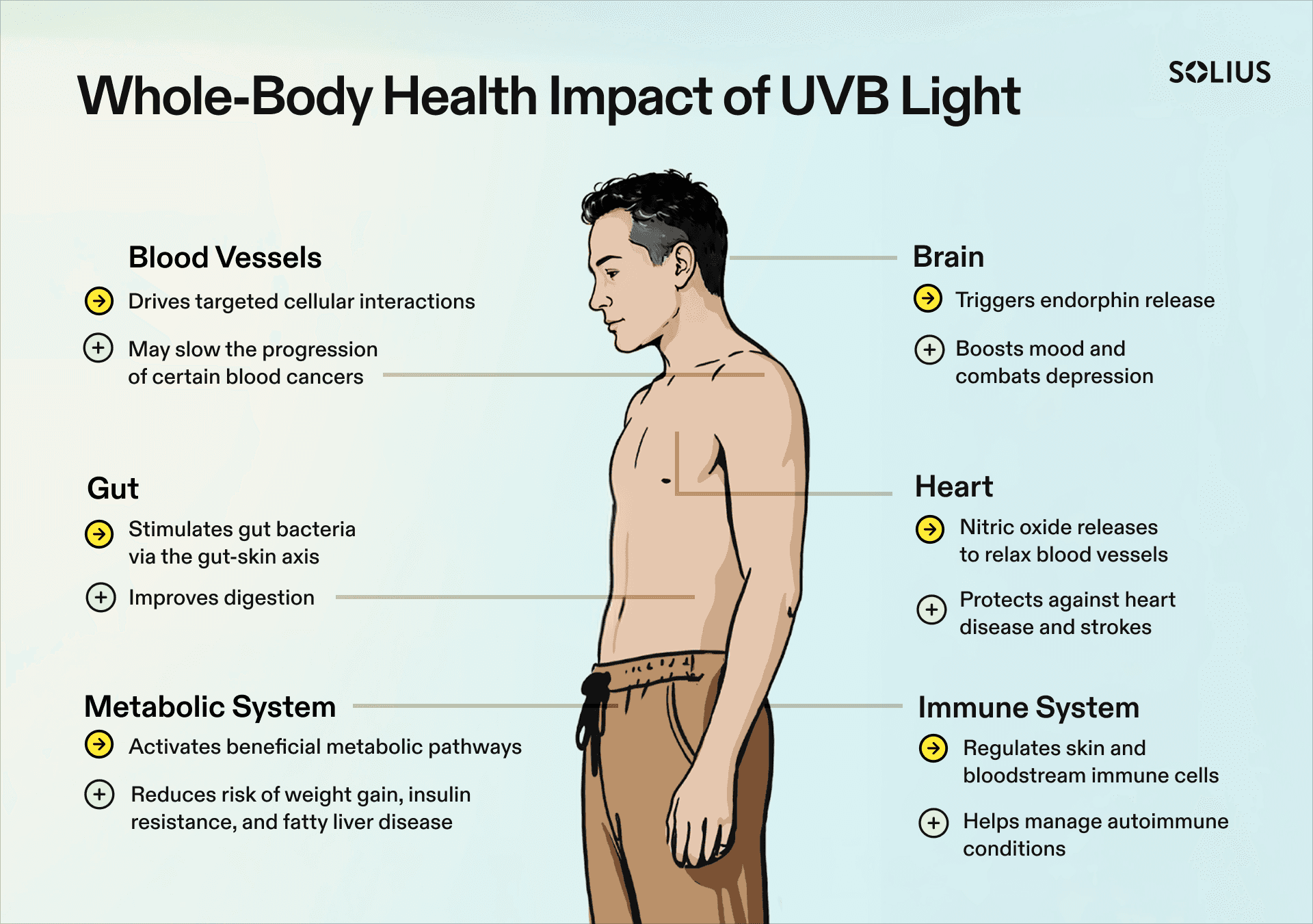
UVB may help boost mood, lower stress, and strengthen cardiovascular health. That’s already a lot of benefits for an invisible light, but these three aren’t the only. Below we’ll explore more possible effects of UVB light.
Mood and stress
Explanation:
“Whenever UVB hits your skin, it causes your body to release endorphins, which are feel good chemicals,” says Dr. Zirwas.
The science to back it up:
A study in the International Journal of Environmental Research and Public Health found that UVB light therapy reduced symptoms in adults with depression.
Cardiovascular health
Explanation:
“When UVB hits your skin, your skin releases a substance called nitric oxide,” says Dr. Zirwas, “And nitric oxide relaxes your blood vessels, so your blood pressure goes down. That is very protective against heart attacks and strokes.”
The science:
A review of available research in the Journal of Investigative Dermatology suggests that adequate UVB exposure is associated with a lower chance of death related to heart disease.
Immune system
Explanation:
“Both your skin and your blood are the two most important parts of your immune system, and UVB hitting your skin and your blood may help regulate your immune system,” says Dr. Zirwas. This might explain why the rates of some autoimmune diseases, such as vitiligo, are lower in those who get enough UVB light. However, Dr. Zirwas cautions that this is not the case for all autoimmune diseases. For people with lupus, UVB light may trigger symptoms, per a 2025 article in the Journal of Autoimmunity.
The science:
A small-scale study suggests UVB light therapy may help improve the quality of life and reduce symptoms for people with multiple sclerosis, per Photochemical and Photobiological Sciences. A larger study in Medicine International suggests it may help treat vitiligo, another autoimmune disease.
Gut health
Explanation:
UVB may stimulate the production of beneficial gut bacteria, due to the gut-skin axis, which is a bidirectional communication pathway between the skin and gut.
The science:
A study in Frontiers in Microbiology supports that UVB light therapy promotes the production of beneficial gut bacteria. Along with boosting overall gut health and digestion, it may be effective at treating specific digestive conditions, such as inflammatory bowel disease (IBD).
Metabolic health
Explanation:
“There is pretty good evidence that UVB reduces metabolic disease,” says Dr. Zirwas, adding that it may help lower the chance of weight gain, insulin resistance, and fatty liver disease. He cautions, however, that this benefit has been found in animal studies, and clinical trials with human participants are necessary in the future.
The science:
A systematic review in the Clinical Biochemist Reviews supports that metabolic benefits have been found in numerous animal studies.
The Challenges of UVB Light
While all these benefits are great, there’s a chance you’re not getting enough UVB from sunlight alone. According to a 2024 review in Current Issues in Molecular Biology, only one to ten percent of the light from the sun is UVB. That’s why many people turn to UVB light therapy devices, which offer a more substantial amount.
It’s also important to note that UVB follows the cliche “too much of a good thing is a bad thing.” High doses of UVB light is associated with sunburn, DNA damage to skin cells, and a higher risk of skin cancer, per a 2021 Biomedicines article. This is yet another reason why you want to be in control of how much you get, which is only possible with a light therapy device.
How Long Does UVB Light Therapy Take to Work?
So, how long does UVB therapy take to work? The answer depends on the reason why someone uses a phototherapy device. If using a narrowband UVB light therapy device for a skin condition, peer-reviewed clinical trials offer some potential timelines. You should discuss with your medical prior to starting treatment as lengths can vary.
Psoriasis: 3-4 months, per the 2025 review in Photodermatology, Photoimmunology & Photomedicine
Eczema: 2-4 months, per a 2024 Trials article
Vitiligo: 3-6 months, per a 2023 article in Dermatology Practical & Conceptual
If you’re using the device more generally (i.e. to promote vitamin D production and for the other benefits discussed above), results may occur faster, and it may require fewer weekly sessions. UVB light has immediate impacts on the body, but long term health benefits come from consistent use over time.
According to clinical trial results in Anticancer Research, full vitamin D benefits may start to become apparent between weeks nine and 13. This may not be the case for all UVB light therapy devices, as this study looked at only one device (Solius).
Condition | Typical number of weekly sessions | Time to response |
Psoriasis | 2-3 sessions | 3–4 months |
Eczema | 2-3 sessions | 2-4 months |
Vitiligo | 2-3 sessions | 3-6 months |
For more general health benefits | Minimum of one session | 2-3 months |
Home UVB Devices: Types Explained
Home UVB devices aren’t created equal. Like “Goldilocks and the three bears,” there are three different types (generally speaking):
Handheld wands: Treats small or localized patches; it’s a handheld wand you “wave” over a specific region.
Targeted panels: Larger with midrange coverage; often hangs on the wall and you step in front of it.
Full-body cabinets: Cover the largest surface area; often a device you step into.
The "goldilocks" size for you depends on why you need the device.
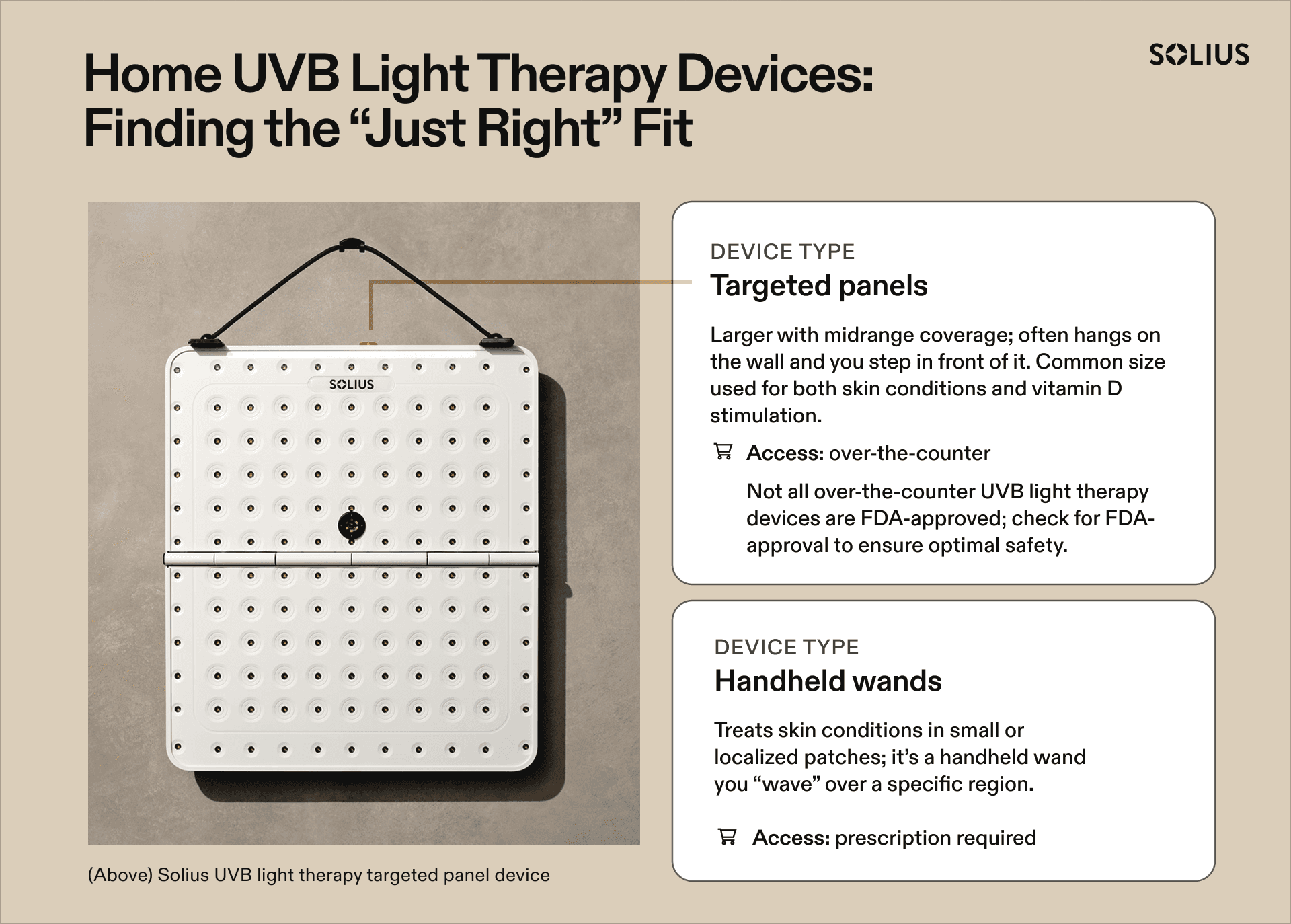
Another important distinction is if a device is FDA-cleared or not. A FDA-cleared device is one that meets standards set by the U.S. Food and Drug Administration. Clearance indicates a device is safe and does what it claims to do.
Prescription devices are FDA-cleared, but most over-the-counter (OTC) UVB light therapy devices can’t claim the same. In fact, Solius is the only FDA-cleared OTC option.
What to Expect During UVB Treatment
UVB light therapy sessions may vary depending on the device used, the reason for using it, and skin tone. Here’s a quick rundown of what a session with Solius looks like:
Therapy length: Approximately five minutes
Therapy frequency: Once a week
What to wear: Remove shirt and wear provided eye protection
First session: The built in sensor analyzes your skin to determine your specific personalized dose.
Post-session care: Remember to moisturize skin and wear sunscreen. When possible, avoid any unnecessary sun exposure on session days.
Side Effects and Safety
While UVB light therapy offers many possible benefits, it also comes with potential side effects. The most common UVB light therapy side effects include:
Itching
Dry skin
Skin redness
Blistering or symptoms similar to sunburn (if overdosed)
Many of these side effects can be prevented by getting a proper dose of UVB light, which is easier said than done. Many devices have standard UVB doses, but we all require different amounts depending on our skin tone and individual sensitivity to light. Per a study published in the Journal of the American Academy of Dermatology, people with dark skin tones require more UVB than those with lighter skin tones in order to see the same effects. That’s why it’s important to choose a light therapy device that personalizes the dose, such as Solius.
Frequently Asked Questions (FAQs)
Can I use a tanning bed instead of UVB therapy?
While a tanning bed may provide some UVB light, 95% of their light output is usually UVA.t’s not recommended to use these devices, as the risks outweigh any possible benefits. According to the FDA, tanning beds increase the likelihood of various health conditions, including skin cancer, cataracts, and sunburn. They’re also associated with premature aging and immune system suppression.
Does UVB light therapy work for everyone?
UVB light therapy is effective for many people, but it doesn’t work for everyone. Its success varies based on the individual’s overall health, how often they use UVB phototherapy at home, and even what light therapy device they use.
What's the difference between UVB and UVA light therapy?
UVA and UVB are two different types of UV light. UVA has a longer wavelength, penetrates deeper into the skin, and is associated with aging as well as a higher risk of skin cancer. UVB light therapy contains UVB light, which offers more health benefits when received in moderation. Many people may benefit from UVB light therapy, as it may help with common skin conditions like psoriasis, boost vitamin D production, and support gut health, mental health, heart health, and more.
Editorial Notes
This article is intended for general informational purposes and does not constitute medical advice. Consult a qualified healthcare provider before making changes to your supplement regimen or sun exposure practices, particularly if you have a medical condition or take medications that may affect vitamin D metabolism.


