


Table of Contents
The question of how to get vitamin D without sun is a tough one. After all, UVB exposure is one of the best, most efficient ways for your body to synthesize vitamin D, a nutrient imperative for bone health, muscle function, immune system support, anti-inflammation, and more. Your clinician may recommend using a variety of tools, including outdoor sun exposure, food sources, supplementation, and UVB light. Here’s what you need to know about increasing your levels when you are insufficient or deficient in this critical nutrient.
Key takeaways
UVB light triggers your skin to produce vitamin D. This is the most efficient way to increase your levels of vitamin D. You can get UVB light from the sun or from a UVB light therapy device.
Additional strategies clinicians may recommend include vitamin D-rich foods like fatty fish or taking a vitamin D supplement.
There are a variety of reasons why your vitamin D levels may not rise appropriately or as expected after supplementation, such as having gastrointestinal health conditions that affect nutrient absorption, a history of bariatric surgery, or obesity, as well as general differences in physiology.
“Eat fatty fish” is probably a refrain rattling around in your brain if you’ve been thinking about how to get vitamin D without sun. And while that’s a good start, it’s likely not enough to increase your vitamin D levels. Depending on your age, you should be getting at least 600 to 800 IU (15 to 20 mcg) of vitamin D daily, though alarmingly, most people don’t get anywhere near what they need from food alone. What that comes down to is identifying the sources that will optimize your vitamin D levels—and making a pointed plan to get there. That might involve:
Eating fatty fish at least twice a week
Taking a vitamin D3 supplement
Consuming D-rich plant foods like UV-exposed mushrooms and fortified non-dairy milks
Starting UVB light therapy
For some folks, all of the above may be part of a strategy to level up your vitamin D. Keep reading on for more insight on why you might be low in vitamin D and what to do about it.
Food Sources of Vitamin D — with Actual Numbers
You’ll find vitamin D in some natural and fortified foods, per the National Institutes of Health Office of Dietary Supplements (ODS):
Fatty fish, per 3-ounce serving
Rainbow trout: 645 IU
Salmon (sockeye): 570 IU
Sardines (2 sardines): 46 IU
Canned tuna: 40 IU
Egg yolks: 44 IU
Mushrooms (UV-exposed varieties only): 366 IU per half cup
Fortified foods (will vary by brand)
Milk: 120 IU per cup
Plant-based milk: 100-144 IU per cup
Cereal: 80 IU per serving
Cod liver oil: 1,360 IU per tablespoon
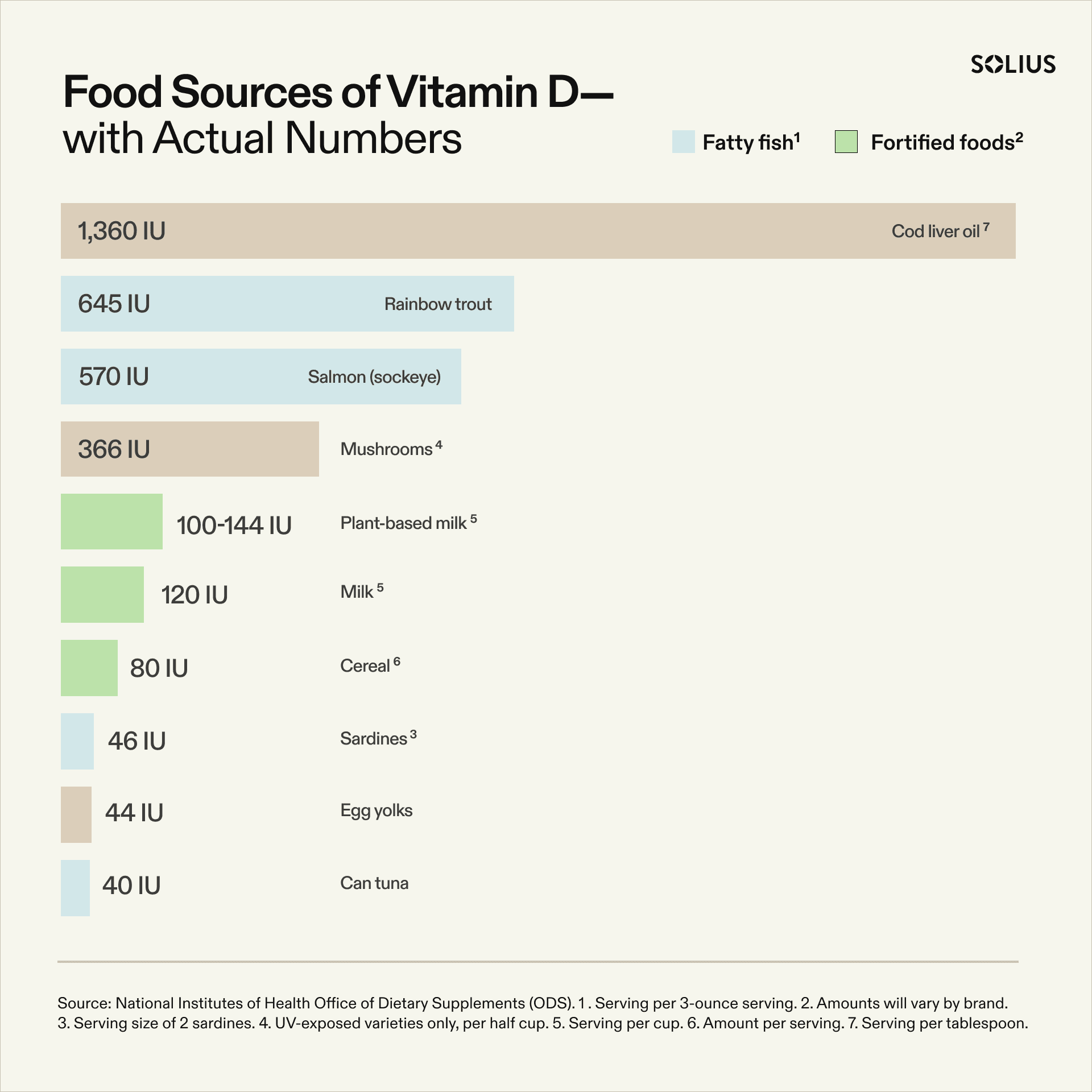
As the ODS points out, getting your required vitamin D from nonfortified foods alone—such as fish, egg yolks, and mushrooms—is difficult. As data shows, most people get, at most, 200 IU of vitamin D from foods per day. An earlier analysis in The Journal of Nutrition found that 100% of Americans consumed less than the estimated average requirement (EAR)from naturally occurring sources.
That doesn’t discount the importance of eating foods high in vitamin D. “Vitamin D-rich foods help support overall vitamin D status, but for many adults, they are unlikely to correct an existing vitamin D deficiency on their own,” says Leigh Frame, PhD, a translational nutrition scientist and executive director of the Office of Integrative Medicine & Health at The George Washington University School of Medicine and Health Sciences. “For someone who is deficient, dietary changes are often an important part of the overall strategy, but supplements are generally a more reliable way to meaningfully improve vitamin D status,” she explains.
Vitamin D Supplements — D3 vs D2, Dosing, and What to Actually Look For
Some people will need to take a vitamin D supplement to get their levels up. If your clinician recommended a supplement for you, here’s what you need to know:
There are two main forms of vitamin D:
D2 (ergocalciferol)
D3 (cholecalciferol)
For people who are taking vitamin D supplements, Frame recommends vitamin D3 vs D2. “Vitamin D3 is more effective at raising and maintaining serum 25-hydroxyvitamin D concentrations, and it is the form naturally synthesized in human skin following UVB exposure,” she explains. One small randomized clinical trial on 33 healthy adults, published in The Journal of Clinical Endocrinology & Metabolism, indicates that the difference in vitamin D absorption was significant, with D3 raising serum vitamin D levels 87% more compared to D2; in addition, D3 storage in the body was two to three times that of D2.
Keep in mind that supplements are part of an effective strategy to increase your vitamin D. They’re not the only one: "Supplements are generally the most consistent and effective way to improve vitamin D status when diet and sensible sun exposure are insufficient,” says Frame.
When choosing a supplement, it’s best to choose a product that is verified by USP, ConsumerLab, or Informed Sport certification. Supplements are not regulated by the FDA, so it’s important to pick products that have undergone additional verification.
The RDA (recommended dietary allowance) for vitamin D is 600 IU for adults (and 800 IU for adults over age 70). This is also in line with the 2024 updated recommendations from the Endocrine Society. In addition, the organization advises taking daily, lower-dose vitamin D instead of a higher-dose vitamin D intermittently (less often throughout the week). Taking your supplement with a meal that contains fat will aid in the absorption of this fat-soluble nutrient.
A specific “best dose” hasn’t been identified, so lean on your clinician’s recommendation. Just keep in mind that GI issues and vitamin D toxicity are possible when taking high doses of supplements. The Tolerable Upper Intake Level set by the National Academies is 4,000 IU/day for adults, though many clinicians consider intakes up to 10,000 IU/day safe for healthy adults when monitored with blood tests. True toxicity generally requires sustained daily intakes well above these amounts.
Why Your Supplement Might Not Be Working
If you’re taking vitamin D supplements or increasing your intake of D-rich foods (or both), you probably expect your vitamin D levels to rise. Sometimes, they don’t, which can be perplexing.
Many reasons can account for this, and several may apply to your situation. Here’s what Frame says may be going on:
You are not consuming enough vitamin D for your needs
You’re living with a health condition that makes absorption more difficult like celiac disease or inflammatory bowel disease (IBD)
You have a history of bariatric surgery, which also impairs vitamin D absorption
You have a weight in the obese category. Excess fat sequesters vitamin D, making it less available to your body to use.
You’re taking a medication that interacts with vitamin D. Those include steroids, cholesterol-lowering drugs, and laxatives, among others.
You are insufficient/deficient in other nutrients. One in particular is magnesium. Magnesium and vitamin D have an important relationship, as magnesium plays an assistive role in vitamin D metabolism. About half of Americans don’t consume enough magnesium in their diet, research suggests.
Even if you’re not in the categories above, you may still differ based on your unique physiology. “Even when taking the same dose, people can achieve very different serum 25-hydroxyvitamin D concentrations because of differences in absorption, metabolism, body composition, and other physiological factors,” says Frame.
For example, vitamin D is fat-soluble, so taking a D supplement with a meal containing healthy fat can help optimize absorption. In addition, there is growing evidence that vitamin D and vitamin K work in tandem, with one specific form, vitamin K2, ensuring that calcium is deposited in your bones where it belongs. For that reason, it may be beneficial to take a vitamin D3 + K2 supplement.
What that boils down to is that a specific dose of vitamin D does not guarantee any outcome. Your clinician should be testing your levels at a planned interval and considering the factors that may affect your body’s ability to absorb or metabolize vitamin D. These factors can also inform the right vitamin D dose for you.
Who needs more than standard advice
If you fit into one of the categories above, you may need extra considerations for increasing vitamin D, per the ODS:
Darker skin tones: Darker skin tones have more melanin (skin pigment), which reduces the skin’s ability to produce vitamin D from the sun, says the NIH. This may increase the risk for vitamin D inadequacy.
Older age: As you age, your skin’s ability to produce vitamin D from the sun diminishes. Plus, there are lifestyle factors at play, including a greater likelihood of spending more time indoors and eating less vitamin D-rich foods.
Malabsorption conditions: Vitamin D is a fat-soluble vitamin, meaning fat is needed for absorption. However, many medical conditions affect dietary fat absorption, including celiac and IBD. In addition, if you’ve had gastric bypass surgery, part of your small intestine was removed, which is where vitamin D is absorbed.
If you live at Northern latitudes and it’s winter: UVB is dependent on the height of the sun, latitude, season, and time of day. In the northern parts of the U.S. during the winter, there is very little UVB present to trigger vitamin D synthesis.
UV Light Therapy — When It Makes Sense and What to Look For
Buying a sunlamp seems like a surefire way to increase your vitamin D, but many devices,such as tanning beds and SAD lamps, emit UVA or visible light. This is a problem. In order for the skin to produce vitamin D, it needs UVB light.
In the light spectrum, UVB sits in the 280 to 315 nm range. If you’re looking at a UVB light therapy device or getting UVB light treatments, keep in mind that UVB light therapy can be used for a couple different purposes and its UVB output varies accordingly. Narrowband UVB, which sits at a peak of 311 to 313 nm, is the clinical standard used in phototherapy treatment for chronic skin conditions. UVB light therapy for this purpose requires either an in-office visit for treatment, which can be expensive, or a prescription for a home device.While these devices can stimulate some vitamin D production in the skin, their output is not optimized for this purpose.
UVB can be is responsible for sunburns when you get too much of it, but the good news is that the dose of UVB you need for optimal vitamin D is lower than what will cause a sunburn, no matter how light or dark your skin tone, according to a research review in JBMR Plus.
And unlike with supplements, you can’t get too much vitamin D from UVB light because your body self-regulates, per the ODS. In addition, if you’re struggling to increase your D levels due to malabsorption issues, a UVB device may be a good option since vitamin D produced from UVB light is not dependent on the gut.
Maintenance vs. Deficiency Correction — The Protocol That Actually Works
Your vitamin D status as it stands today matters in terms of next steps:
If you’re in maintenance
If you have healthy vitamin D levels, continue to eat foods rich in vitamin D, such as fatty fish and fortified foods. Seek regular and responsible sun exposure. Consider UVB light therapy to optimize your personal vitamin D needs. Take a vitamin D3 supplement when recommended by your clinician.
If you have a confirmed deficiency
Get clear with your clinician on the exact protocol to follow, including whether supplementation is needed, and if so whether loading (taking a high dose for the initial weeks) is needed. You’ll also want to discuss maintenance dosage, strategies for including dietary sources, utilizing UVB light therapy, and how co-occurring health conditions might influence absorption and how to account for these. Set a follow-up appointment with your clinician to assess levels and retest to confirm levels are rising. Note, though, that you don't need to talk to your doctor in order to start over-the-counter UVB light therapy, but it’s always good to keep them informed.
For anyone
Whether you’re struggling with deficiency or squarely in maintenance mode, outdoor exposure to UVB light through natural sunlight is an important component in keeping your vitamin D levels in a healthy range. “Humans evolved to synthesize vitamin D in response to UVB sunlight, making sensible sun exposure the body’s primary natural source of vitamin D,” says Frame. “Sensible” is key here: “The goal is to expose the skin long enough to stimulate vitamin D production without allowing it to become pink or burn.” Once you have red skin or a sunburn, then that UV exposure has tipped into damaging, “undoing much of the good,” Frame adds.
Research in the International Journal of Environmental Research and Public Health suggests that during high UVB seasons (spring, summer), five to 30 minutes of outside time per day, depending on skin type and the UV index, will be sufficient. Take care to avoid sunburn and wear sunglasses to protect your eyes. That said, UVB light is not always easily available from the sun, even if you’re getting outside. Your skin’s ability to synthesize vitamin D depends on a variety of factors, including time of year, weather, clothing, sunscreen use, and skin tone. In these cases, UVB light therapy may be a good alternative or addition.
What’s more, Frame points out that diet, supplements, and sensible sun exposure can be tools that complement each other. “The goal is to use the combination that safely helps an individual achieve and maintain a healthy vitamin D status,” she says.
Should You Test? What Number to Aim For
Over the past 20 years, rates of vitamin D testing have skyrocketed, per the Endocrine Society. That makes sense: The majority of the U.S. population is insufficient or deficient in vitamin D, according to research in Frontiers in Nutrition.
If you’re concerned, consider asking your clinician about a 25-hydroxyvitamin D (25(OH)D) blood test to evaluate your levels. That’s especially true if any of the below apply to you, according to an article in Endocrine Reviews:
You’re over 50 years old
You don’t get much sun (applies to wintertime, those in Northern latitudes, anyone who spends most of their time indoors, such as at an office job)
You have a dark skin tone
You’re exposed to a lot of smog or air pollution
You have a restrictive diet
You have a GI condition that affects absorption, such as inflammatory bowel disease or Celiac disease
You’ve had prior bariatric surgery
You have a BMI in the overweight or obese range
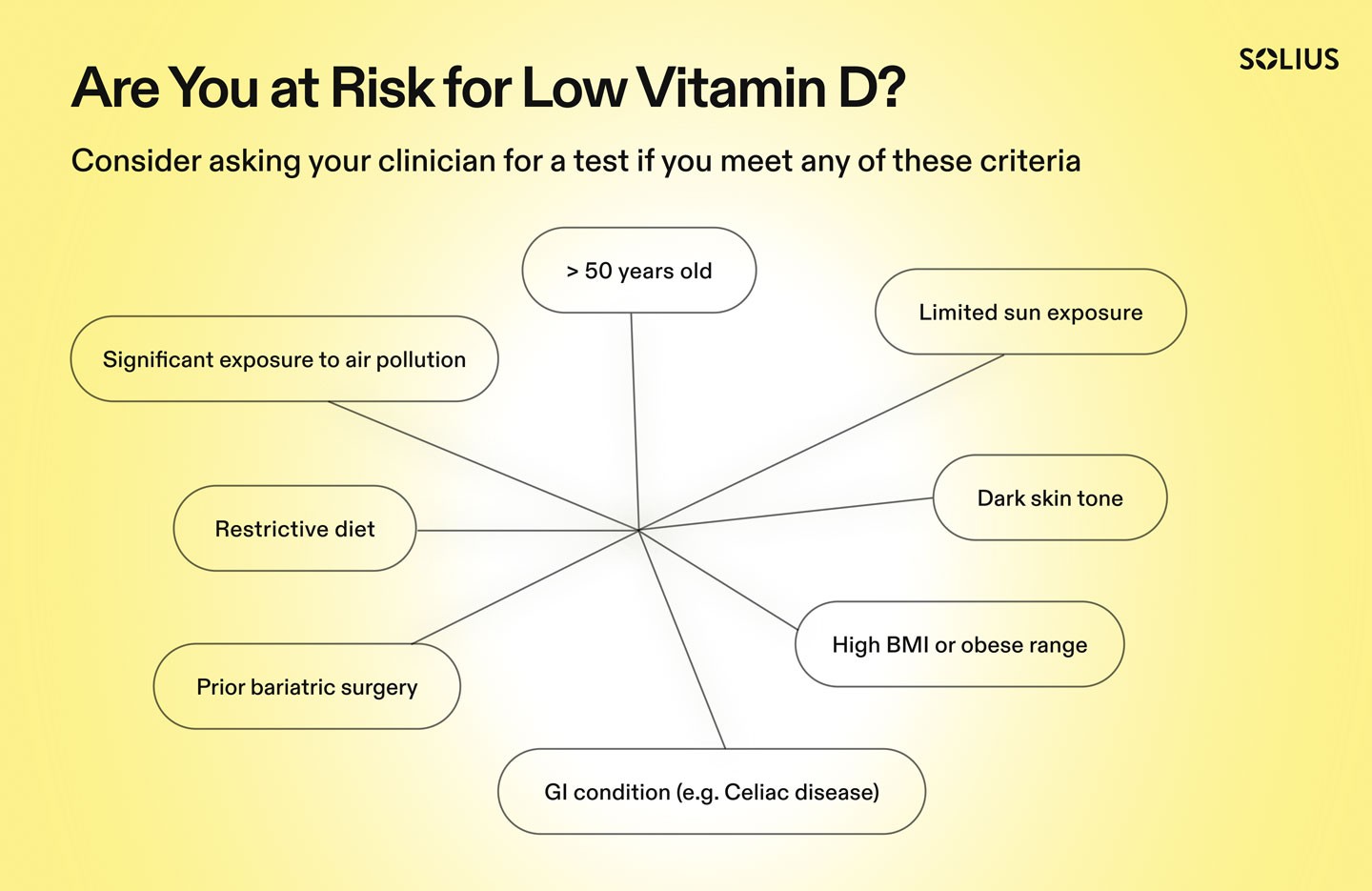
As for the results you’re aiming for: Although the optimal vitamin D level is still debated, major worldwide organizations advise 25(OH)D levels to be between 20-30 ng/mL(50 to 75 nmol/L), according to Endocrine Reviews. However, many researchers and scientific organizations, including GrassrootsHealth, a public health research organization that has tracked vitamin D levels across large cohorts, recommend a target range of 40-60 ng/mL (100-150 nmol/L) based on its scientific panel's review of the data.
The bottom line
UVB light from the sun triggers skin to produce vitamin D and is an important component in keeping vitamin D levels in the healthy range. Non-sun strategies that may complement regular, responsible outdoor exposure are vitamin D-rich foods, vitamin D supplements, and UVB light therapy. Several factors influence your body’s ability to produce vitamin D, including your individual physiology, skin tone, where you live, the season, and more. Talk to your clinician about testing your vitamin D levels, especially if you’re concerned that they may be low.
Frequently asked questions (FAQs)
Can you get enough vitamin D from food alone?
Across the board, people generally do not get enough vitamin D from food alone. Responsible sun exposure remains the best free way to get vitamin D, but can be difficult to access on a consistent basis. While some people may benefit from taking a vitamin D supplement, others may look to UVB light therapy as another option.
What is the best vitamin D supplement to take?
If your clinician has recommended starting a vitamin D supplement, look for the form of vitamin D called D3 (cholecalciferol). Your body better absorbs this form of vitamin D compared to D2 (ergocalciferol).
Can you get vitamin D from a UVB light?
Yes. At the proper wavelength, UVB light can trigger vitamin D synthesis in the skin while greatly limiting the UV exposure risk that exists with the sun. However, prolonged UV exposure can lead to skin damage and skin cancer so appropriate length of use is important.
Can you get vitamin D through a home or office window?
No. UVB radiation, which is needed to stimulate vitamin D production from the skin, does not get through glass. You need outside exposure to the sun or a UV lamp to get vitamin D.
Editorial Notes
This article is intended for general informational purposes and does not constitute medical advice. Consult a qualified healthcare provider before making changes to your supplement regimen or sun exposure practices, particularly if you have a medical condition or take medications that may affect vitamin D metabolism.


