
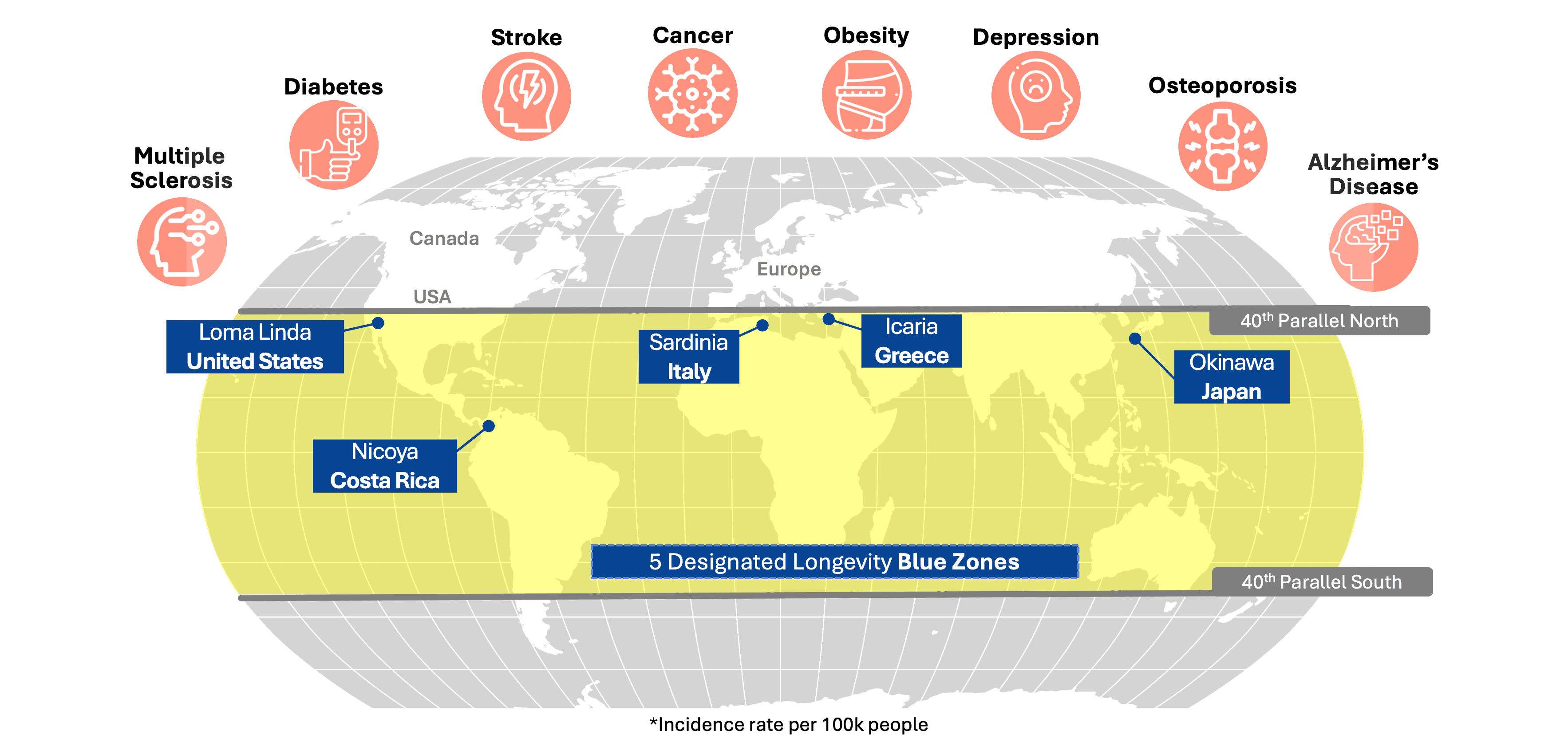
Populations in lower-sun latitudes show higher rates of multiple chronic diseases, largely attributed to reduced UVB-driven vitamin D synthesis and other non-vitamin-D biological pathways.
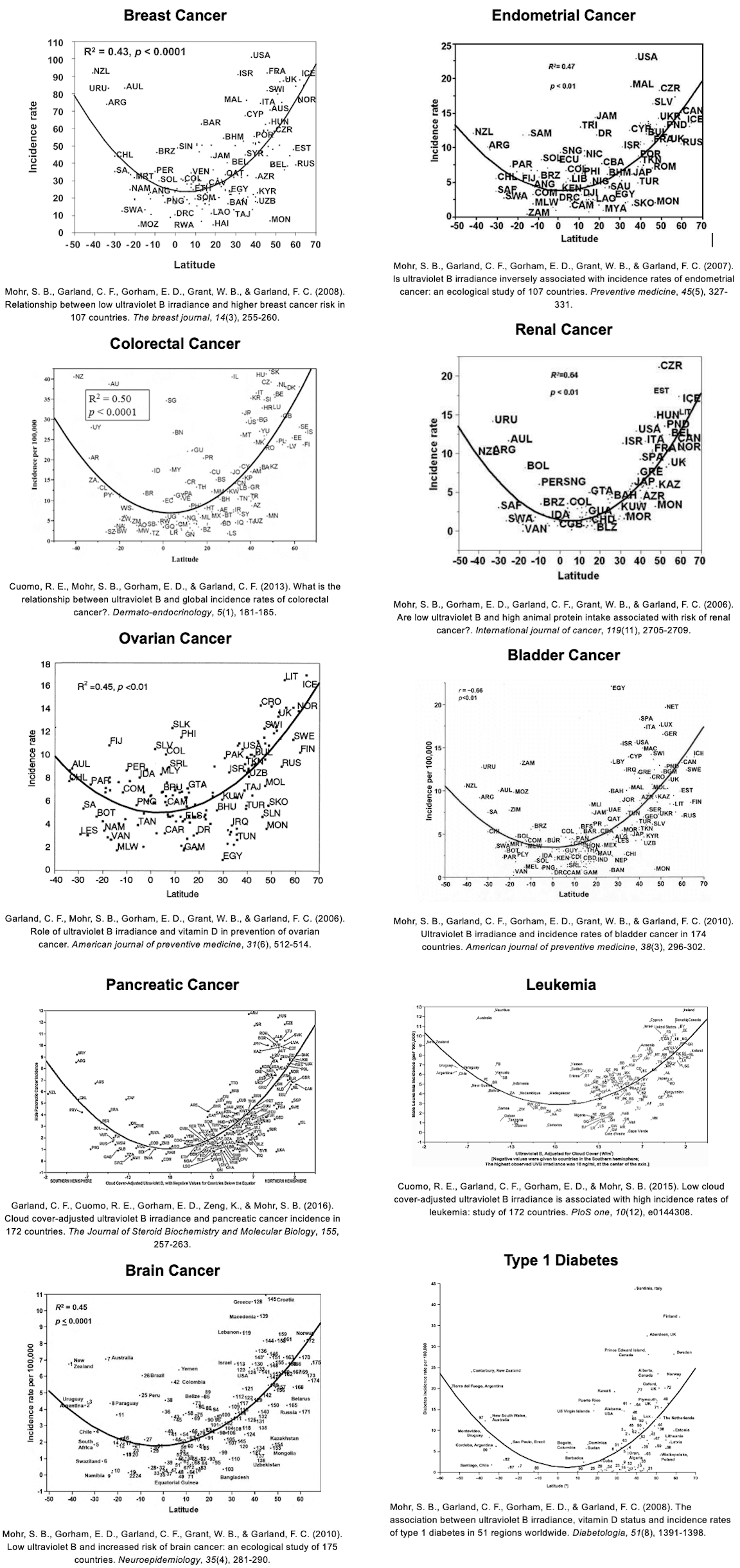
Cancer
UVB associated with lower age-adjusted cancer mortality across geographic regions.
Grant, W. B., & Garland, C. F. (2006). The association of solar ultraviolet B (UVB) with reducing risk of cancer: Multifactorial ecologic analysis of geographic variation in age-adjusted cancer mortality rates. Anticancer Research, 26(4A), 2687–2699.
Breast Cancer
Lower UVB irradiance linked to higher breast cancer risk across 107 countries.
Mohr, S. B., Garland, C. F., Gorham, E. D., Grant, W. B., & Garland, F. C. (2008). Relationship between low ultraviolet B irradiance and higher breast cancer risk in 107 countries. The Breast Journal, 14(3), 255–260. https://doi.org/10.1111/j.1524-4741.2008.00576.x
Diabetes
Lower UVB and vitamin D status tied to higher diabetes incidence across 51 regions.
Mohr, S. B., Garland, C. F., Gorham, E. D., & Garland, F. C. (2008). The association between ultraviolet B irradiance, vitamin D status, and incidence rates of type 1 diabetes in 51 regions worldwide. Diabetologia, 51, 1391–1398. https://doi.org/10.1007/s00125-008-1061-5
Multiple Sclerosis
Low sun exposure increases MS risk both directly and through vitamin D.
Hedström, A. K., Olsson, T., Kockum, I., Hillert, J., & Alfredsson, L. (2020). Low sun exposure increases multiple sclerosis risk both directly and indirectly. Journal of Neurology, 267, 1045–1052. https://doi.org/10.1007/s00415-019-09695-2
Stroke
Associated lower sunlight radiation with higher stroke incidence.
Kent, S. T., McClure, L. A., Judd, S. E., Howard, V. J., Crosson, W. L., Al-Hamdan, M. Z., & Kabagambe, E. K. (2013). Short- and long-term sunlight radiation and stroke incidence. Annals of Neurology, 73(1), 32–37. https://doi.org/10.1002/ana.23738
Depression
Found sunlight exposure correlated with mental health outcomes.
Wang, J., Wei, Z., Yao, N., Li, C., & Sun, L. (2023). Association between sunlight exposure and mental health: Evidence from a special population without sunlight in work. Risk Management and Healthcare Policy, 16, 1049–1057. https://doi.org/10.2147/RMHP.S401311
Alzheimer’s / Dementia
In a study of over 362,000 participants, linked less outdoor light time to higher dementia risk.
Ma, L. Z., Ma, Y. H., Ou, Y. N., Chen, S. D., Yang, L., Dong, Q., Cheng, W., Tan, L., & Yu, J. T. (2022). Time spent in outdoor light is associated with the risk of dementia: A prospective cohort study of 362,094 participants. BMC Medicine, 20(1), 132. https://doi.org/10.1186/s12916-022-02317-7
Obesity / Metabolic Health
Connected vitamin D status to cardio-metabolic risk factors.
Muldowney, S., Lucey, A. J., Paschos, G., Martinez, J. A., Bandarra, N., Thorsdottir, I., & Kiely, M. (2011). Relationships between vitamin D status and cardio-metabolic risk factors in young European adults. Annals of Nutrition and Metabolism, 58(2), 85–93. https://doi.org/10.1159/000323999
Osteoporosis
Found latitude affects hip fracture risk and seasonal variation in Sweden.
Odén, A., Kanis, J. A., McCloskey, E. V., & Johansson, H. (2014). The effect of latitude on the risk and seasonal variation in hip fracture in Sweden. Journal of Bone and Mineral Research, 29(10), 2217–2223. https://doi.org/10.1002/jbmr.2254
WHO / Sunlight Report
Mead, M. N. (2008). Benefits of sunlight: A bright spot for human health. Environmental Health Perspectives, 116(4), A160–A167. https://doi.org/10.1289/ehp.116-a160