
Table of Contents
The Big Picture
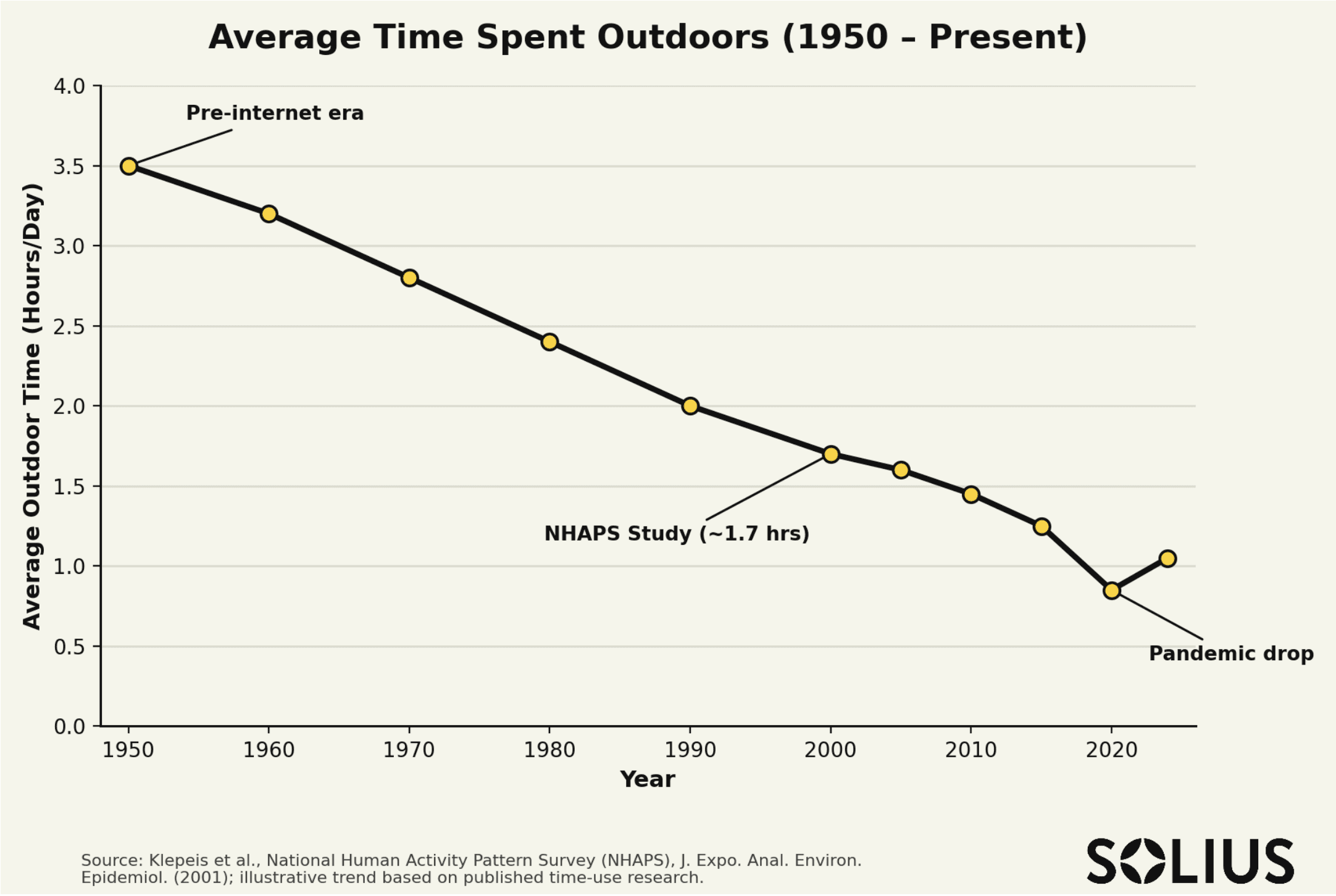
Average outdoor time has fallen from roughly three and a half hours a day in 1950 to under an hour today, and over that same stretch, rates of the diseases most closely tied to sunlight exposure — multiple sclerosis, myopia, depression, and a long list of cardiovascular and autoimmune conditions — have climbed. Researchers increasingly believe this is not just coincidence. Humans evolved at the equator, under intense UV light, and our skin itself was shaped generation after generation by the expectation of regular sun exposure. Science journalist Rowan Jacobsen makes this case in his book In Defense of Sunlight: The Surprising Science of Sun Exposure, and the research he cites shows that moderate, regular sun exposure is linked to lower rates of heart attack, stroke, obesity, diabetes, dementia, depression, and more. Getting outside consistently isn’t always realistic given modern work, climate, and geography. That’s the gap Solius is built to close.
Why We're Talking About Sunlight and Disease Right Now
For decades, the message from dermatology and public health has been simple: the sun is dangerous, and the safest amount of exposure is none. But time-use data collected by the EPA's National Human Activity Pattern Survey (NHAPS) found that Americans spend about 87% of their time indoors and another 6% in enclosed vehicles, leaving a sliver of the day for direct sunlight. That shift away from the outdoors has tracked closely with rising rates of several chronic diseases, and a growing body of research suggests the two trends are connected.
Below, we unpack the evolutionary case for why human skin depends on sunlight, what's changed about how we live, what the research shows about the health costs of that change, and where a personalized UVB device like Solius fits into closing the gap.
Born at the Equator, Built for the Sun
Modern humans evolved in equatorial Africa roughly two million years ago, under some of the most intense ultraviolet light on Earth. Early hominids lost their body hair and developed dark, densely pigmented skin as a direct response to that environment. Melanin acted as a natural sunscreen, protecting against UV damage while also protecting folate, a nutrient that excess UV exposure degrades and that is essential for healthy reproduction. Dark skin wasn't a cosmetic accident. It was a finely tuned adaptation to a life spent almost entirely outdoors, near the equator.
As populations migrated north and south away from the equator over tens of thousands of years, they ran into a different problem. UVB radiation, the specific wavelength responsible for triggering vitamin D synthesis in skin, becomes weaker and more filtered at higher latitudes, especially in winter. Skin that had evolved to block UV in order to protect folate now blocked too much of it to make adequate vitamin D. The evolutionary response was lighter skin: populations that settled in northern Europe and Asia gradually lost pigmentation because lighter skin absorbs limited available UVB more efficiently, allowing enough vitamin D synthesis to support survival and reproduction in a comparatively sun-starved environment.
Our skin, regardless of tone, was shaped generation after generation by the expectation of regular sun exposure. Vitamin D synthesis isn't a side effect of going outside - it's one of the core reasons our skin looks and behaves the way it does.
The Great Indoor Migration
For nearly all of human history, spending most of the day outside wasn't a choice, it was simply what life required. That changed with startling speed. Industrialization moved work indoors. Electric light made it possible to be productive after dark. Cars replaced walking, air conditioning made staying inside more comfortable than stepping outside, and screens gave us compelling reasons to stay there.
The numbers reflect just how far the shift has gone. Beyond the NHAPS finding above, outdoor recreation researchers have tracked a steady, decades-long decline in daily outdoor time from the mid-twentieth century onward, a decline that took its sharpest recent dip during the COVID-19 pandemic. For most people living and working in modern cities, meaningful daily sun exposure is no longer a byproduct of daily life. It has to be deliberately sought out, and most people no longer seek it out.
What We Lost When We Went Inside
Multiple Sclerosis and the Latitude Gradient
Multiple sclerosis is one of the clearest examples of what researchers call the "latitude gradient": a 2021 study in the journal Brain followed MS prevalence patterns and confirmed that risk rises the further a population lives from the equator, with the gradient established as early as birth and driven largely by early-life sun exposure. Norway and Sweden, both far from the equator with limited sunlight for much of the year, have some of the highest MS rates in the world, while equatorial regions report far lower incidence. Vitamin D functions as a hormone that helps regulate the immune system, and because MS is fundamentally an autoimmune disease, the biological link between inadequate UVB exposure and disease risk isn't a stretch.
The Myopia Epidemic
Myopia tells a similar story from a different angle. A 2025 review in the European Journal of Public Health notes that 47.2% of 20-year-olds in Europe are now nearsighted, compared with just 13.9% in the 1960s - a shift too rapid to be explained by genetics alone. A meta-analysis of outdoor time and myopia risk found that, compared with roughly 3.5 hours of outdoor time per week, increasing outdoor time to 7, 16.3, and 27 hours per week corresponded with a 20%, 53%, and 69% reduction in myopia onset, respectively. When a public health program in Yilan, Taiwan required two hours of daily outdoor activity for kindergarteners starting in 2014, myopia prevalence among preschoolers fell from 15.5% to 8.4% within two years, and stayed low even through the pandemic.
Cardiovascular Disease, Mood, and All-Cause Mortality
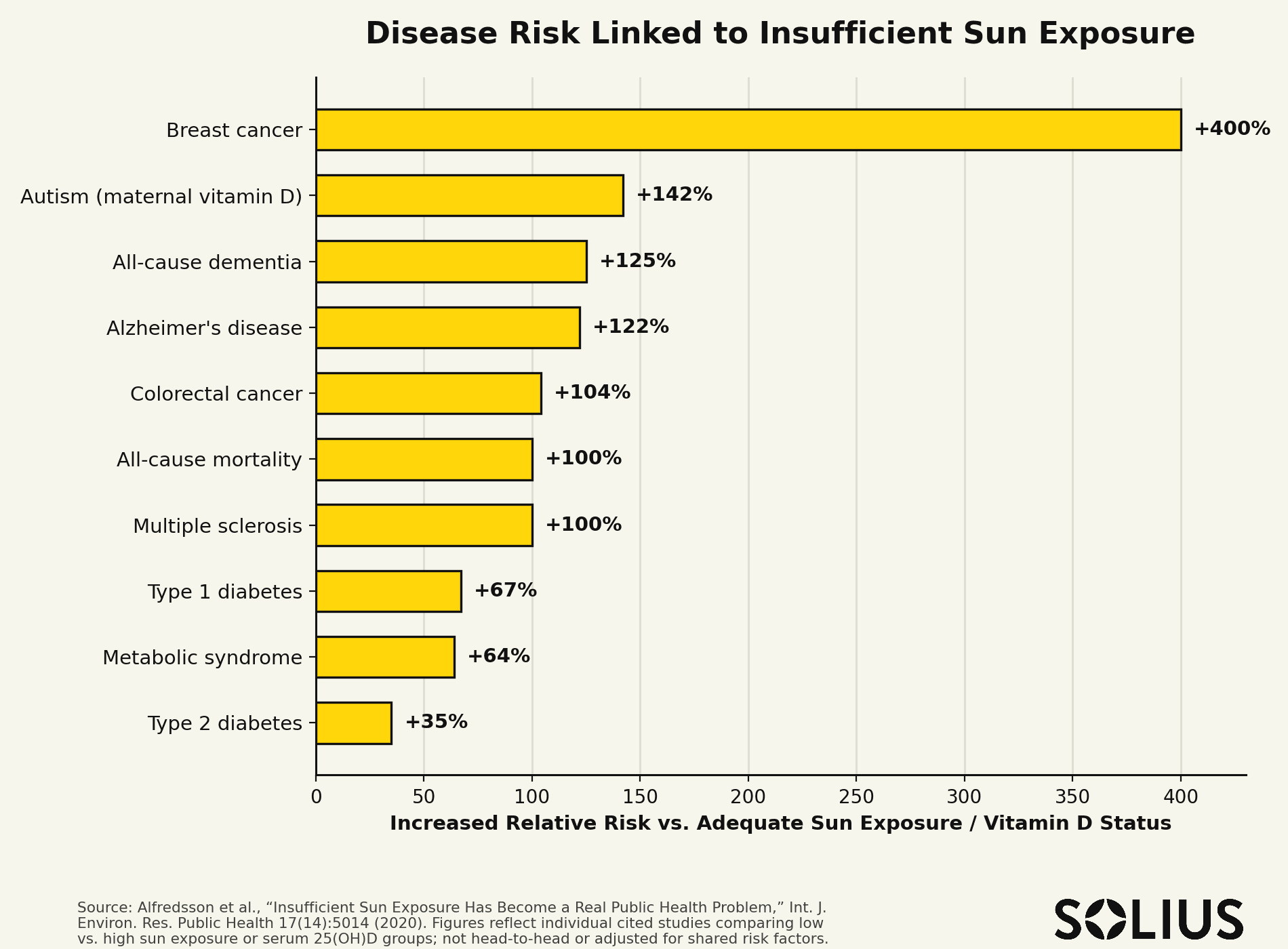
Some of the strongest evidence on the broader cost of sun avoidance comes from a long-running Swedish cohort. Research published in the Journal of Internal Medicine followed nearly 30,000 women and found that all-cause mortality among women who avoided sun exposure was roughly twice as high as among women with the highest sun exposure. A follow-up analysis found that non-smokers who avoided the sun had a life expectancy similar to smokers who got the most sun, effectively putting sun avoidance in the same risk category as smoking for overall mortality. In his book, Jacobsen builds on research like this to lay out the case that inadequate sun exposure is also linked to elevated rates of heart attack, stroke, obesity, type 2 diabetes, dementia, depression, Parkinson's disease, and respiratory infections.
How the Science Got This Backward
If moderate sunlight is this beneficial, why has the dominant public health message for decades been unqualified avoidance? Jacobsen traces the shift in reputation directly: in 1926, The Lancet described sunbathing as one of nature's greatest aids to health. By the 1950s, as skin cancer research advanced, sunlight had been recast as something closer to a hazard to avoid outright.
The concern about skin cancer is legitimate, but Jacobsen argues it's been generalized well beyond the population it actually applies to. A systematic review in the Journal of Surgical Research examining occupational sun exposure found that melanoma risk is driven far more by intermittent, intense sunburns than by steady, cumulative sun exposure, and that indoor workers who occasionally sunburn on vacation can carry higher melanoma risk than people who work outdoors and receive regular, moderate exposure. Public health guidance, built primarily around the highest-risk group of very fair-skinned people, was applied uniformly to everyone, in part because broad, simple messaging is easier to communicate than nuance. As Jacobsen puts it, the guidance that actually reflects the science is closer to: get sun, not too much, go outside.
A Body Still Waiting for Its Dose
The mechanisms behind sunlight's benefits go beyond vitamin D, though vitamin D is an important part of the picture. UV exposure also triggers the release of nitric oxide in the skin, which helps dilate blood vessels and lower blood pressure through a pathway distinct from vitamin D entirely. Sunlight appears to reduce chronic low-grade inflammation, implicated in a huge share of modern chronic disease, by acting as a mild, beneficial stressor that activates the body's own repair processes, similar to the effect of moderate exercise. And light hitting the skin and eyes each day plays a central role in setting the body's circadian rhythm, the internal clock that governs when the body repairs itself overnight and when it operates at full capacity during the day.
Notably, Jacobsen points to evidence that vitamin D taken as a supplement doesn't replicate the full range of benefits produced by sunlight hitting the skin directly. That distinction matters: the goal isn't simply hitting a vitamin D number on a lab report, it's restoring an input the body was designed to receive directly, regularly, and through the skin.
Closing the Gap for Modern Life
Here's the difficulty: even fully convinced of the science, most people can't simply go back to spending three and a half hours outdoors every day. Modern work schedules, climate, geography, and the reality of winter across much of the world make consistent, adequate, safe sun exposure genuinely hard to achieve on a regular basis, no matter how motivated someone is.
We've already proven this is possible for nearly every other part of an active, outdoor life. We can run on a treadmill, bike on a Peloton, row on a Hydrow, climb on a VersaClimber, and ski on a SkiErg, recreating decades of outdoor physical activity entirely indoors. The one input none of these machines can recreate is usable UVB light, which is exactly the gap a device built specifically for that purpose needs to close.
This is the gap Solius was built to close. Solius is an FDA-cleared, personalized UVB light therapy device that delivers the specific wavelength of light responsible for triggering the body's natural vitamin D production and the other beneficial pathways sunlight activates. A patent-pending skin analysis system calibrates the dose to an individual's own skin tone, and a session takes about five minutes a week. It isn't a replacement for the outdoors, and it isn't meant to be. It's a way to keep a dose of what our biology has always depended on flowing even when the season, the schedule, or the latitude gets in the way. In an independent study conducted at Boston University, Solius use produced an average increase of 10.2 ng/mL in vitamin D levels, a 76% mean increase from participants' baseline.
The Takeaway
Human skin evolved for regular sun exposure. Dark skin developed at the equator to protect folate; lighter skin developed at higher latitudes to make the most of limited UVB for vitamin D synthesis.
Outdoor time has collapsed over the past seventy years. Americans now spend about 87% of their time indoors, according to EPA-sponsored research, down from a much more outdoor-centered daily life in 1950.
Disease rates tied to inadequate sun exposure have risen alongside it, including multiple sclerosis, myopia, and, per Swedish cohort data, all-cause mortality comparable in magnitude to smoking.
The skin cancer message, while valid for high-risk groups, has been over-applied. Intermittent burns, not steady moderate exposure, appear to drive most of the added melanoma risk.
Consistent, moderate sun exposure isn't realistic for everyone, every season. Personalized UVB therapy like Solius is designed to help close that gap safely.
Editorial Notes
This article is written for general education and does not replace individualized medical advice. Sun exposure recommendations vary by skin type, geography, and personal health history — consult a healthcare provider before making significant changes to sun exposure habits.